
Oct 19, 2026
Whistleblowing Investigation Workflow: From Intake to Closure

Keep the ENTIRE article in English. Never translate it, never switch language, not even for a single word.
Table of contents
- Required structure — preserve exactly
- What to improve
- Hard rules
- Key takeaways
- What does a defensible whistleblowing investigation workflow look like from intake to closure?
- How to triage and acknowledge a report within 7 days without compromising anonymity
- How should evidence be collected, preserved, and chained during a whistleblower case?
- When and how should the reporter be interviewed (and when should they not be)?
- How do you decide between informal resolution, formal investigation, and closure with no action?
- What does a proper closure memo contain so the case survives an external audit?
- Whistleblowing investigation workflow checklist and common failure points
- Frequently asked questions
- Sources
Required structure — preserve exactly
- Keep every one of these H2 headings, in this order and spelled exactly as written:
- What does a defensible whistleblowing investigation workflow look like from intake to closure?
- How to triage and acknowledge a report within 7 days without compromising anonymity
- How should evidence be collected, preserved, and chained during a whistleblower case?
- When and how should the reporter be interviewed (and when should they not be)?
- How do you decide between informal resolution, formal investigation, and closure with no action?
- What does a proper closure memo contain so the case survives an external audit?
- Whistleblowing investigation workflow checklist and common failure points
- Keep every internal link intact as an inline Markdown link
[anchor](url)with the EXACT url given — do not drop it, reword the URL, or move it into a separate list: - pricing
- investigating whistleblower report anonymously
- eu whistleblowing directive
- rollen rechte compliance
- pravidlo ctyr oci
What to improve
- Make every section fully and directly answer its own heading; delete sentences that do not.
- Replace generic filler with concrete, specific guidance: steps, examples, realistic scenarios, trade-offs.
- Remove repetition and redundancy across sections; tighten wordy sentences; keep paragraphs short (2-4 sentences).
- Fix awkward or non-native phrasing and keep terminology consistent throughout.
- Keep the length at about 2500 words.
Hard rules
- NEVER invent facts, numbers, prices, product details, certifications, or sources that are not already in the article.
- Do NOT add, remove, rename, or reorder sections.
- Output ONLY the revised Markdown article body — no commentary, no preamble, no code fences.
A reporting channel without a defensible whistleblowing investigation workflow is a liability waiting to happen. Receipts arrive at all hours and in every shape — anonymous web forms, encrypted mail, voicemail transcripts — and the difference between a case that survives an external audit and one that unravels in front of a regulator is the discipline of the process that handles them.
The end-to-end workflow below is the one compliance officers actually run: a defensible line from the first notification to a signed closure memo, with anonymity preserved at every step and the audit trail intact.
Key takeaways
- The EU Whistleblowing Directive imposes a seven-day acknowledgment window and a three-month feedback deadline, so the first week of a case sets the legal tempo for everything that follows.
- A defensible workflow has six stages: intake, triage, evidence preservation, fact-finding, decision, and documented closure — each with its own owner and timestamp.
- Anonymity is not a feature you switch on; it is a chain of decisions from intake form design through to how interview notes are stored and who is allowed to read them.
- Evidence preservation beats evidence collection: chain-of-custody discipline matters more than the volume of material gathered.
- A closure memo is the artefact an external auditor or regulator will ask for first; if it cannot stand on its own, the case is not closed.
What does a defensible whistleblowing investigation workflow look like from intake to closure?
A defensible whistleblowing investigation workflow has six clearly separated stages — intake, triage, evidence preservation, fact-finding interviews, decision on how to resolve, and documented closure — with named owners, deadlines, and a written audit trail at each handoff.
Under the EU Whistleblowing Directive (Directive 2019/1937), the workflow must also respect two statutory clocks: an acknowledgment within seven days of receipt and feedback to the reporter within three months (EUR-Lex, Directive 2019/1937).
In practice the six stages look like this.
- Intake. The reporter submits through an approved channel, the system records metadata only (timestamp, channel, category), and the report enters the case file.
- Triage. A trained case owner classifies the report, screens for conflicts, and acknowledges receipt to the reporter within seven days.
- Evidence preservation. Anything touched in the case is logged, hashed where possible, and held under restricted access — the chain of custody starts here, not later.
- Fact-finding. Interviews, document review, and limited system access happen behind a strict need-to-know rule, with interview notes captured contemporaneously.
- Decision. A small decision-making body chooses between informal resolution, formal investigation, or closure with no action, and records why.
- Closure. A closure memo summarises the allegations, the process, the findings, the rationale, and the protections put in place for the reporter.
The discipline that holds the workflow together is separation of roles: the person who receives a report is not the person who investigates it, and the person who decides the outcome is not the person who wrote the memo. The compliance officer's job is to keep that triangle intact on every case.
How to triage and acknowledge a report within 7 days without compromising anonymity
Triage is the 24-to-72-hour window after receipt when the case owner confirms the report is real, classifies its severity, screens for conflicts of interest, and sends an acknowledgment that respects the reporter's chosen channel. The acknowledgment must reach the reporter within seven days of receipt under Article 5(1)(c) of Directive 2019/1937 (EUR-Lex, Directive 2019/1937).
A clean triage pass follows this sequence.
- Verify the channel and timing. Confirm the report came through an approved intake route and note the exact timestamp of receipt.
- Read the report only on a vetted device. Avoid printing, avoid forwarding, and avoid opening attachments on a personal device or shared drive.
- Classify by category and severity. Match the allegation to a fixed taxonomy (fraud, harassment, safety, data protection, retaliation, other) and flag anything that triggers an immediate legal hold.
- Screen for conflicts. If the named subject is the case owner's manager, the CEO, or anyone in the case owner's reporting line, escalate the assignment before reading further.
- Send the acknowledgment. A short, neutral message confirming receipt, naming the case owner role (not the individual), setting expectations for next contact, and reaffirming non-retaliation protections.
Two anonymity pitfalls catch first-time case owners. The first is acknowledgment leakage: a reply that addresses the reporter by name, or references a detail only identifiable insiders would know, strips the cloak of anonymity in one sentence. The second is metadata leakage: sending the acknowledgment from a mailbox that copies the reporter's manager, cc'ing a working group, or sending it from a personal device tied to the office network.
Both can be eliminated by routing all reporter communication through a dedicated channel and by training the case owner on investigating a whistleblower report anonymously before the first case lands.
What should the seven-day acknowledgment actually say?
It should confirm receipt, name the role responsible for the case (not the person's name), reference the case identifier the reporter will use, restate the prohibition on retaliation, and explain when and how the next contact will happen.
It should not request identifying details, repeat the substance of the report, or commit the organisation to a specific outcome.
How should evidence be collected, preserved, and chained during a whistleblower case?
Evidence in a whistleblower case has to be preserved, not merely collected. The chain of custody starts the moment a piece of information enters the case file, and every subsequent touch is logged with a timestamp, the actor, and the reason. A defensible record answers four questions for any artefact: who handled it, when, where, and why.
The standards the case will be measured against are familiar from any forensic discipline: integrity (the artefact has not been altered), authenticity (it is what it claims to be), completeness (no relevant gap is hidden), and traceability (every access leaves an entry).
The French CNIL's guidance on whistleblower channels and the UK ICO's employment practices guidance both treat documentation discipline as the load-bearing element of any EU whistleblowing directive-aligned programme.
A practical preservation routine.
- Assign a single evidence custodian per case. Multiple hands handling original material is the single most common cause of broken chain of custody.
- Hash on intake. Record a SHA-256 hash of every digital artefact at the moment it enters the case file; verify the hash before any later access.
- Maintain a written chain-of-custody log. Every transfer — who gave what to whom, when, for what purpose — gets a row with signatures or equivalent system attestation.
- Hold originals, work on copies. Investigators review redacted, watermarked copies; originals stay in restricted access.
- Restrict access by role. Only the case owner, the decision body, and named legal reviewers can read the case file; technical logs record every read.
- Set a legal hold trigger early. Once a regulator, court, or external auditor becomes plausible, freeze relevant evidence and document the freeze.
A persistent failure pattern is deferring preservation until "if we need it". By the time the need is clear, mailbox auto-deletion, log rotation, and laptop refreshes have already eaten the most useful material. Evidence preservation in a whistleblower case is a same-day discipline.
How long does an organisation need to keep case files?
For matters within the EU Whistleblowing Directive's scope, case files and the related report must be kept for as long as may be necessary to fulfil the directive's obligations and for the duration of any relevant limitation period. National transpositions vary, so the operating rule is to mirror the longest statute of limitations attached to the underlying allegation. Personal data not relevant to the case must be deleted as soon as the case is closed.
When and how should the reporter be interviewed (and when should they not be)?
The reporter should be interviewed when their account needs to be tested against documents, when there are factual gaps that only they can fill, or when the reporter has explicitly asked for a follow-up. The reporter should not be interviewed when doing so would expose their identity to the subject of the report, when the matter can be resolved without their further input, or when there is a credible risk of retaliation in the interview setting itself.
Interview decisions are governed by three constraints: anonymity, safety, and proportionality. An interview that is not strictly necessary is not a neutral act — it is a data-processing event, a memory-writing event, and sometimes a witness-exposure event, and each of those carries obligations under GDPR.
What does a well-run whistleblower interview look like?
A well-run interview happens by default through the same channel the reporter used to send the report. The interviewer asks open questions, takes contemporaneous notes, reads the notes back at the end for accuracy, and never records audio without explicit consent. Two interviewers are present, one to ask and one to take notes, separated from the investigation itself so they can act as witnesses to the process.
A short, signed or system-attested summary is added to the case file. The full transcript, where one is made, is stored under the same restricted access as the rest of the case.
When is a follow-up interview the wrong move?
When the only outcome the interview can produce is more detail on the same facts already documented, the interview adds risk without value. The same applies when the reporter has indicated they want no further contact, when the substantive questions can be answered by documents, and when the case has already reached the threshold for handing evidence to a regulator.
In each of those cases the case owner should document the decision not to interview, and the reasons, so the choice is auditable later.
How do you decide between informal resolution, formal investigation, and closure with no action?
The decision is made by a small, named decision body — typically the compliance officer, a legal representative, and an independent reviewer drawn from HR or audit — after reviewing the triage, the preserved evidence, and any witness accounts. Three outcomes are available: informal resolution, formal investigation, or closure with no action.
The decision is not a formality. It is the moment the case either escalates into a process that may lead to disciplinary action, regulatory disclosure, or litigation, or it stops on the merits. Each branch has its own threshold, its own documented rationale, and its own obligations to the reporter.
- Closure with no action is appropriate when the allegation, even taken at its highest, does not meet the threshold for a process — for example, a vague grievance with no identifiable fact pattern.
- Informal resolution is appropriate when the matter can be addressed without a finding of misconduct — a low-level interpersonal dispute, a one-off process error that can be remediated, a clarification that resolves a misunderstanding.
- Formal investigation is appropriate when the allegation, if substantiated, would amount to misconduct, breach of law, or a material risk to the organisation, and the evidence supports moving from triage into fact-finding.
What separates informal resolution from closure with no action?
Informal resolution accepts that something happened and intervenes to put it right; closure with no action concludes that nothing requires intervention. The distinction matters because informal resolution typically triggers remediation steps and a check-back, while closure with no action triggers the protection of the reporter and the deletion of personal data that is no longer needed.
The decision memo should make the distinction explicit so it is intelligible to an external reviewer.
When is a formal investigation unavoidable?
When the allegation, on its face, describes conduct that would constitute a criminal offence, a breach of a regulator's rules, or a serious breach of internal policy, and the evidence available at triage is sufficient to move beyond mere suspicion, formal investigation becomes not just appropriate but unavoidable — and the failure to investigate carries its own legal exposure.
What does a proper closure memo contain so the case survives an external audit?
A proper closure memo records the case identifier, the receipt date, the seven-day acknowledgment timestamp, the three-month feedback date, a neutral summary of the allegation, the process followed, the evidence considered, the findings on the balance of probabilities, the rationale for the decision, the remediation steps, and the protections in place for the reporter.
It is signed by the decision body and stored under restricted access for the full retention period. Under Directive 2019/1937, feedback to the reporter on action taken must be provided within three months of the acknowledgment (EUR-Lex, Directive 2019/1937).
A defensible memo has the same shape every time, which is the point. An external auditor or regulator does not need to agree with the conclusion; they need to be able to follow the reasoning, verify that each step in the intake to closure investigation process was followed, and confirm the case met the directive's procedural minimums.
What belongs in the findings section, and what does not?
The findings section sets out what was established, what was not, and the standard of proof applied. It does not name the reporter, does not reproduce identifying details from the underlying allegation, and does not include speculation, motive theories, or material drawn from sources outside the evidence chain.
The findings section is the most-litigated part of the memo and is the part a regulator will quote back to the organisation.
How do you write a defensible rationale?
State the decision (informal resolution, formal investigation with outcome, closure with no action), the alternative outcomes that were considered and rejected, the evidence supporting the chosen outcome, and the residual risks the organisation has accepted by closing the case. A rationale that names the rejected alternatives survives scrutiny better than one that justifies only the chosen path.
Whistleblowing investigation workflow checklist and common failure points
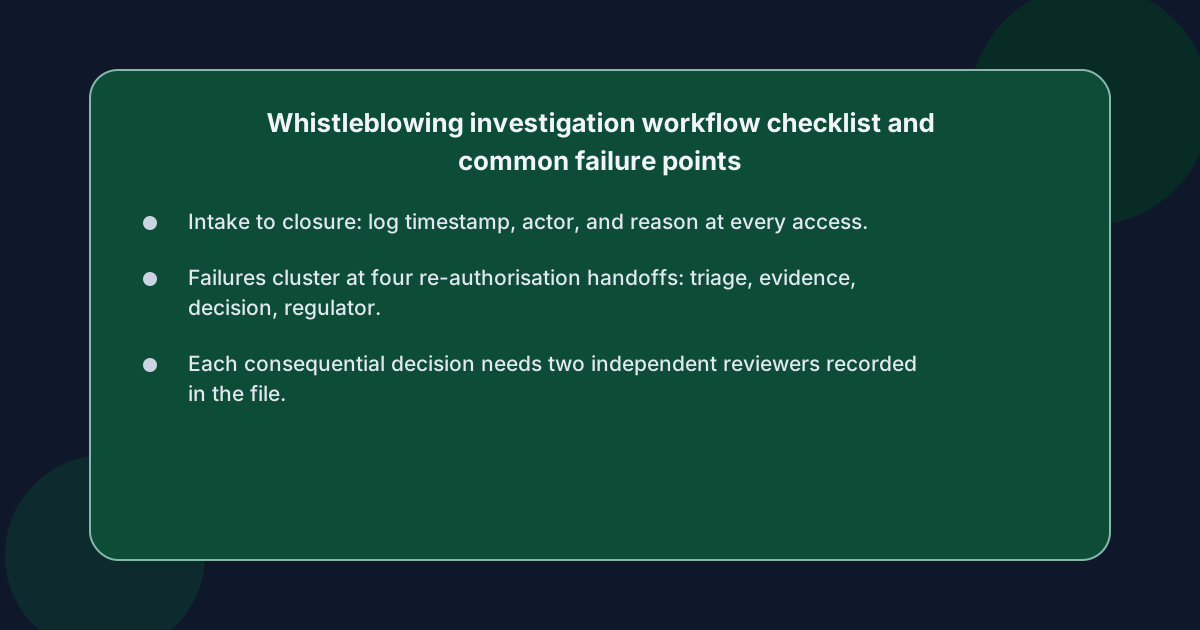 Use this checklist as a one-page reference at the close of every case. Each item maps to a stage in the workflow above; each failure point is one that compliance officers see repeatedly in post-case reviews.
- Approved reporting channels are published and reachable in every language the workforce uses.
- Receipt is timestamped at intake and entered into the case file within 24 hours.
- Conflicts of interest are screened before the case is assigned.
- The seven-day acknowledgment is sent through the reporter's chosen channel and does not include identifying details.
- Evidence is hashed on intake and held by a single named custodian.
- Every access to the case file is logged with timestamp, actor, and reason.
- Interviews, where held, follow the two-interviewer rule and produce contemporaneous notes.
- The three-month feedback date is visible on the case file from day one.
- The decision body is named, separate from the investigator and the case owner.
- The closure memo follows the standard template and is signed by the decision body.
- Personal data not needed for the case is deleted on closure.
- Protection against retaliation is reaffirmed to the reporter at closure.
Where do investigations most often fail?
They fail at the handoff points: the moment the case moves from triage to investigation, the moment evidence moves between custodians, the moment the decision is made, and the moment the case is handed to a regulator or external auditor. Each of those moments is a re-authorisation event, and re-authorisation is where anonymity gets stripped, evidence integrity gets questioned, and the timeline stops being reconstructable.
A second, less visible failure mode is what compliance officers call "process drift". The workflow that worked for the first ten cases stops being followed at the hundredth, because shortcuts accumulate, training is skipped, and the case owner changes. Regular case-file audits — pulling a random sample every quarter and walking the file against this checklist — are the cheapest insurance a programme can buy. Role and permission separation inside the tooling, set up so that no single account can both receive reports and decide on outcomes, is the most durable defence against drift; a clear matrix of rolls and permissions for compliance teams turns an aspirational rule into a system constraint.
What is the four-eyes principle and how does it apply here?
The four-eyes principle — two independent people reviewing any consequential decision — applies to every consequential decision in a whistleblower case: the triage decision, the evidence-access decision, the interview decision, the outcome decision, and the closure decision. A single person making any of those calls, even with good intent, is a control gap a regulator will name.
The principle is operational, not philosophical. It requires that both reviewers be independent of the subject of the report and of each other, and it requires that the second reviewer's conclusion be recorded. For the underlying control design, see the four-eyes principle reference.
How does technology change the workflow without changing the standards?
Technology changes how the workflow runs, not the standards it has to meet. A purpose-built whistleblowing platform can enforce the seven-day and three-month deadlines automatically, hold report content encrypted so even the vendor cannot read it, log every access immutably, and make the triage of a whistleblower report faster and more consistent than an inbox.
The standards — separation of roles, chain of custody, three-month feedback, retaliation protection — are set by Directive 2019/1937 and by the case law that surrounds it. Tooling that helps a team meet them is one option among several; the compliance officer's job is to make sure the standard is met regardless of the tool. For organisations comparing options, pricing is a useful first filter, but the test is always whether the tool enforces the controls above, not how it is sold.
Frequently asked questions
What are the legal deadlines in a whistleblowing investigation?
A whistleblowing investigation in scope of the EU Whistleblowing Directive has two key deadlines: an acknowledgment of receipt within seven days and feedback on action taken within three months. National transpositions in EU member states set the same minimums, and some — including Germany's Hinweisgeberschutzgesetz — add shorter notification windows. The seven-day clock starts when the report lands in an approved channel, not when the case owner first reads it, and the three-month clock starts from the acknowledgment, not from receipt.
Who should own a whistleblower case internally?
The case owner should be a trained compliance or investigations professional who is not in the reporting line of the subject of the report and who has no operational stake in the underlying allegation. In larger organisations the case owner runs the day-to-day work while a separate decision body — typically legal, compliance, and an independent reviewer — takes the outcome decision. Separation of the case owner from the investigator and from the decision body is the load-bearing control in most mature programmes.
Can a whistleblower report be investigated without interviewing the reporter?
Yes. A reporter's account is one input into the investigation, not a required one. Many cases are resolved on documents alone, especially when the reporter has explicitly asked for no further contact or when the matter can be substantiated or refuted from email, system logs, or witness statements. The decision to interview or not to interview is itself an auditable step and should be documented in the case file with the reasoning.
What counts as retaliation against a whistleblower and how is it prevented?
Retaliation is any act, omission, or threat that causes, or is likely to cause, harm to a reporter because they made a report, including dismissal, demotion, negative performance review, reassignment, disciplinary action for unrelated matters, reputational damage, and blacklisting within an industry. The strongest prevention is structural: the case owner and decision body operate independently of the subject's reporting line, the reporter's identity is protected by process design, and any HR action affecting the reporter within 24 months of a report triggers an automatic independence review.
Is anonymity the same as confidentiality in whistleblower cases?
No. Confidentiality means the reporter's identity is known to a small, named set of people who are legally bound not to disclose it; anonymity means the reporter's identity is not known to anyone inside the organisation. Directive 2019/1937 protects both, but the operational implications differ. An anonymous report can be acted on but cannot receive identity-bound feedback; a confidential report is more usable but creates a small group of people who must be trained, vetted, and held accountable.