
Oct 14, 2026
How to Investigate a Whistleblower Report Without Breaking Anonymity

The hardest part of a whistleblower investigation is not finding facts — it is gathering them without ever being able to ask the reporter who they are. This walkthrough shows how a defensible investigation looks from first triage to closed case file.
It is written for the person whose job is figuring out how to investigate a whistleblower report while keeping the person who raised it invisible to everyone except the people who need to know, and only for as long as they need to know it.
The procedures below assume you are operating inside an EU legal entity bound by the EU Whistleblowing Directive, but the underlying discipline holds wherever regulators expect an anonymous channel and an auditor-acceptable record.
Table of contents
- Key takeaways
- What does 'investigating a whistleblower report' actually mean?
- How do you triage a report in the first 24 hours?
- Asking follow-up questions without exposing the reporter
- Preserving an evidence chain an auditor will accept
- When (and how) to escalate from case worker to compliance committee
- Closing the case: feedback, retention and the immutable activity log
- A worked timeline: 7-day acknowledgment to 3-month feedback
- Checklist: anonymity-preserving investigation do's and don'ts
- Frequently asked questions
- Sources
Key takeaways
- Acknowledge receipt within seven days and give substantive feedback within three months — these are not best-practice suggestions, they are minimum obligations set out in Directive (EU) 2019/1937.
- Triage has to happen in the first 24 hours: separate what is in scope, what is already public, and what touches a protected reporter's identity.
- Treat every follow-up question as a leak risk: prefer structured, multiple-choice or yes/no questions phrased around facts, not persons.
- Audit-ready evidence is built by design, not added at the end: write down, time-stamp and lock every action the moment you take it.
- Escalation is a documented decision with a documented reason, not a judgment call between two people on a video call.
What does 'investigating a whistleblower report' actually mean?
Investigating a whistleblower report is the structured process of determining whether an allegation is true, what harm or risk it reveals, and what the obligated entity must do next — performed without ever asking the reporter to identify themselves, and while producing a written record an auditor, regulator or court can reconstruct years later.
The scope is narrower than a normal internal inquiry in three ways. First, the reporter's identity, when it exists at all, is information you cannot solicit, store, or share. Under Directive (EU) 2019/1937, the duty of confidentiality binds anyone handling a report, and breach of that duty is itself an offence in several national transpositions.
Second, the subject being investigated is usually an employee, manager or third party the organization already knows. That is why the report itself, not the reporter, has to carry the weight of the allegation.
Third, every procedural step has to survive a later test of proportionality: was the inquiry necessary, was its scope the minimum required, and was the record sufficient to show that?
What it does not mean is also worth stating up front. It is not a criminal prosecution, a labour-court dispute or a disciplinary hearing; those are downstream actions that may or may not follow. It is not an opportunity to test whether you can find out who the reporter is, even when the law allows the reporter to consent. And it is not a substitute for the everyday work of an internal audit, compliance monitoring or HR investigation, which run on different evidentiary rules and longer cycles. A report is one input, not an investigation in itself.
The deliverable of a good investigation is a closed case file: a decision on the facts, a record of every action, the reasoning behind each escalation, the feedback sent back to the reporter within the legal window, and a retention decision that matches the data-protection rules you operate under. Everything in the rest of this article is in service of that file.
How do you triage a report in the first 24 hours?
Triage in the first 24 hours means classifying the report into one of three buckets — in scope, out of scope, or already known — assigning a single accountable case owner, acknowledging receipt to the reporter, and writing down the classification and its reasoning before anyone touches the substance of the allegation.
The clock is the first thing to manage. Directive (EU) 2019/1937 gives a reporting person the right to receive an acknowledgement of receipt within seven days of submission.
In practice the safest interpretation is to treat the seven days as an outside limit and acknowledge within 24 to 48 hours. Every later deadline in the case — including the three-month feedback window — counts from acknowledgement, not from intake. Marking that timestamp correctly in your internal reporting channel is the single most important piece of case discipline.
The triage itself runs through four quick questions, in this order.
Is it in scope? In-scope reports are those alleging breaches falling within the material scope of Directive (EU) 2019/1937:
- Public procurement
- Financial services
- Product safety
- Transport safety
- Environmental protection
- Radiation protection
- Food and feed safety
- Public health
- Consumer protection
- Privacy and network security
- EU financial interests
- Internal market
- Breaches affecting EU funding
Anything else, including purely interpersonal HR grievances, sits outside the directive's protected scope — which does not mean it should be ignored, only that the regime surrounding it is different.
Is it already substantiated by public material? If the report cites a news story, an audit finding or a regulator's open decision that you can read without further investigation, the triage conclusion is "verify, do not investigate from scratch." Open the file, attach the public source, and write down the verification step.
Does it name or implicate a person the reporter could be? A report that describes "two people in finance" carries less identity risk than one that says "my direct line manager." Triage is the moment to redact, flag or move a report into a higher-anonymity track — including, in the extreme case, declining to investigate specific persons and addressing the systemic issue instead.
Does the report describe an ongoing or imminent risk? Imminent harm to people, customers, markets or critical infrastructure overrides the normal investigative timetable and goes straight to the duty person designated in your internal policy. The fact that you escalated — and the time you escalated — goes into the file, not the conversation that decided it.
The output of triage is a short written note: classification, assigned owner, acknowledgement action, any immediate-risk escalation, and a list of the next investigations steps the owner will take. It is dated, signed, and stored with the report. From this point on the case file is the single source of truth.
Asking follow-up questions without exposing the reporter
Asking follow-up questions without exposing the reporter means restricting the conversation to facts the reporter can answer without self-identification, routing every exchange through the same anonymous channel, and recording the question and the answer as a single timestamped pair inside the case file.
The temptation in a real investigation is to write an open-ended message — "Tell us more about what you saw, and please include the dates." That message is unsafe for a simple reason: it gives the reporter no help in staying anonymous.
A reporter who has to write a paragraph explaining the timeline is a reporter who will, almost without noticing, include cues that identify them: their role, their team, their office, the projects they work on, sometimes their own name out of habit. The job of the investigator is to design questions that do not require the reporter to make those choices.
That means three habits, in every follow-up exchange.
What kinds of questions are safe to ask a whistleblower?
Safe follow-up questions are closed or multiple-choice questions about facts a stranger could answer: dates, locations among a closed set, document identifiers, the presence or absence of a specific event, or a yes/no about a defined step in a process.
A question like "Between June and September, did the contract mentioned in your original report go through a second approval step?" is safe. A question like "Who else was on that call?" is not. The reporter can answer the first without saying anything about themselves; the second forces them either to refuse to answer or to mention other named people, which in turn forces the investigator to handle identifiers the report was meant to keep out of the system.
Safe questions also avoid asking the reporter to perform work on the investigator's behalf. Asking someone to "send us the email so we can verify the headers" is a request that leaks metadata; even an experienced reporter may not realise that what they forward carries information they did not intend to share. Where evidence is required, it is almost always safer to retrieve it independently — from systems the organization controls, from logs, from third parties — than to ask the reporter to send it.
How should follow-up exchanges be recorded in the case file?
Record every follow-up exchange as a timestamped, paired record: the question sent, the answer received, the medium used, and the investigator who handled the exchange — without storing anything that would let a later reader reconstruct the reporter's identity outside the protected group.
Pairing matters because half a record cannot be defended. An auditor who sees "Question: …" with no answer cannot tell whether the investigator asked the right question or whether the reporter withdrew; an investigator who has the answer but not the question cannot show what they did with the information. The pair is the unit of evidence.
The medium matters too. A substantive follow-up question routed in a way the reporter did not choose — by phone to an unmasked extension, by post, via a third-party messaging app — is a confidentiality breach even if the reporter's identity would not, in fact, be exposed.
The breach test is not "were we able to find out who they are"; it is "could we have." The medium has to be the same one the reporter used to come to you.
Preserving an evidence chain an auditor will accept
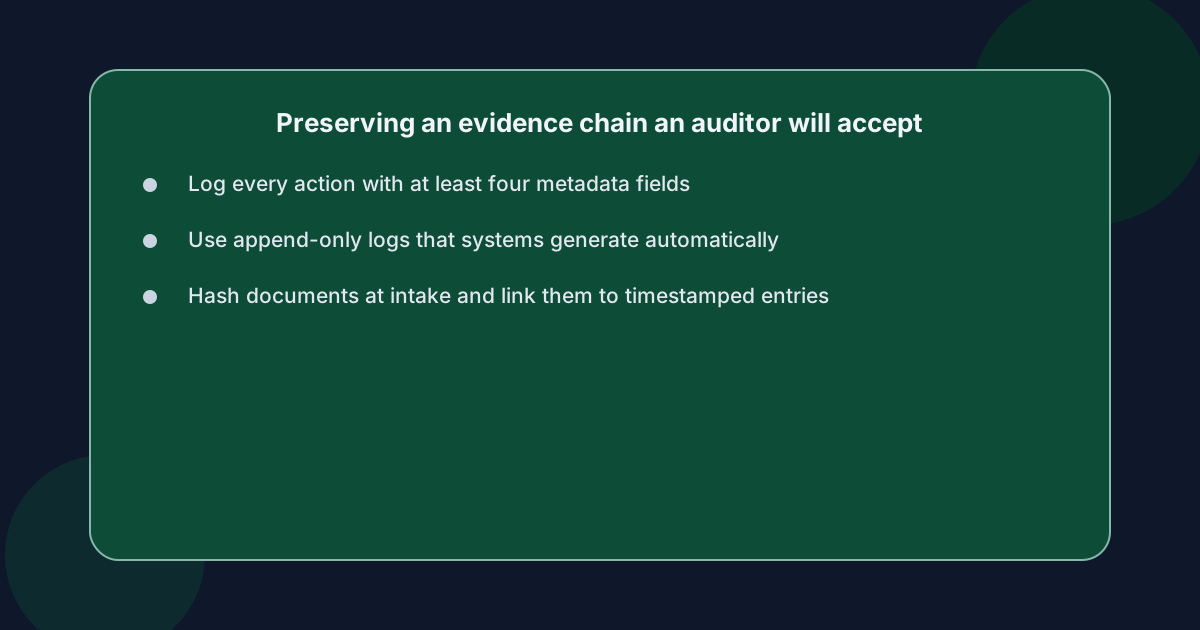 Preserving an evidence chain an auditor will accept means treating the case file as the primary record of the investigation, with every piece of supporting evidence hashed, time-stamped, and stored with a written record of who collected it, who handled it, and why.
An evidence chain is not a forensic process reserved for criminal cases; it is simply a discipline for showing that what is in the case file is what was there when it was collected. Auditors test for it because the alternative — a file that any actor could have rewritten — provides no protection to anyone, including the reporter. The minimum viable chain is four pieces of metadata for every item of evidence: what it is, when it was obtained, from whom or from where, and how it has been stored since.
Three habits make this work in practice.
What should an auditor expect to see in a whistleblower case file?
An auditor expects a complete, time-ordered log of every action taken on the case — from acknowledgement to closure — paired with the underlying documents, communications, and decision notes that explain each step.
The log has to cover actions, not just events. Two actions that look identical ("reviewed document") tell the auditor nothing; the same action described with the reviewer named, the document version, the question being investigated and the conclusion reached does.
Where possible, the log should be generated by the case-management system rather than typed afterwards, because typed logs invite the very corrections that auditors want to disprove. Where a record cannot be system-generated — a phone call, an in-person interview — it should be written up immediately, signed, and added to the file.
How is evidence integrity maintained when the reporter is anonymous?
Evidence integrity is maintained by separating the reporter's communications from the underlying factual material, restricting access to each layer to the people who need it, and never treating anonymity as something to be broken later in the name of thoroughness.
The separation is structural. The reporter's channel — the inbox, the messages, the metadata that ties them to the channel — sits in a layer accessible only to the designated handlers; the underlying evidence — logs, documents, system records — sits in a layer accessible to the wider investigation team. The two layers meet only in the case file, under version control, with the join logged. The aim is to allow an investigator to do the work without ever needing to know who the reporter is, and to allow a later audit to verify that nobody did.
This is one of the places where the discipline of anonymous reporting earns its name. The wrong model — one where the case worker has to know the reporter's identity to do the work — couples the legal duty of confidentiality to the operational mechanics of the case and creates a single point of failure. The right model decouples the two: the investigator does the work on the facts, the duty-bound handlers do the work on the reporter relationship, and neither side reads the other's notes by default.
What counts as a defensible evidence record?
A defensible evidence record is one where the chain of custody is reconstructable, the integrity of the underlying material is provable, and the record itself is tamper-evident — meaning any later modification leaves a trace the auditor can see.
Provability is mostly a technical question. Hashing documents at the moment they are added to the file, attaching the hash to the time-stamped entry, and refusing to overwrite earlier versions gives a later auditor a way to check that nothing was silently edited. Tamper-evidence, in turn, comes from system design: append-only logs, role-based access, and the absence of any "delete and re-add" workflow that a participant could plausibly perform. Where the underlying system cannot provide those guarantees by itself — for example, when the investigator has had to collect material from an uncontrolled mailbox — the gap is closed with a written, signed chain-of-custody record.
A separate concern is the integrity of the case-management environment itself. The audit trail that lives inside the file only carries weight if the platform it sits on cannot be silently rewritten. For organisations operating under security and GDPR obligations, the defensibility of the file is in practice a property of the channel it is built on, not only of the discipline of the investigator using it.
When (and how) to escalate from case worker to compliance committee
Escalating from case worker to compliance committee means transferring responsibility for the investigation at a defined threshold — typically when the allegation touches senior management, when the legal exposure is material, or when the case worker is no longer the appropriate decision-maker — and documenting the transfer as a discrete event in the case file.
Escalation is one of the most over- and under-used steps in an investigation. Under-used, because routine cases become hard cases when the committee only learns about them after closure. Over-used, because every escalation widens the circle of people who know the report exists, and every widening is a confidentiality risk that has to be justified.
The right model is to write the escalation triggers into the internal policy in advance, so the decision is not a judgment call on the day. Common triggers are: the report names a person at director level or above; the allegation, if substantiated, would constitute a criminal offence; the financial exposure crosses a stated threshold; the report concerns a member of the compliance team itself; or the case worker is unable to gather the evidence they need without institutional authority. Anything that fits a written trigger is escalated automatically; anything that does not is handled by the case worker.
How is the scope of an escalation limited?
The scope of an escalation is limited to the committee and the chair; supporting materials are summarised, the reporter's identifying metadata is excluded by default, and the committee's remit is the decision, not the full investigation.
A common mistake is to send the committee the entire case file. Even where the committee is the right body to decide, the file still contains the reporter's channel metadata, the reporter's own language, and a dozen incidental details that the committee does not need to do its job. The standard discipline is to prepare an escalation note: the allegation, the evidence so far, the legal exposure, the proposed next step, and the question for the committee. The underlying file remains with the case worker; the committee acts on the summary and writes its decision back into the file.
The decision itself is what belongs in the case file, not the deliberation. Committee minutes are recorded under their own confidentiality regime; the case file gets a dated, signed record of the decision, the rationale, the voting if any, and the instructions to the case worker. That keeps the two layers separate and protects the committee's own deliberations from being read into the investigation by accident.
Closing the case: feedback, retention and the immutable activity log
Closing the case means giving the reporter substantive feedback within the three-month window, deciding what the file will be retained for and on what legal basis, and locking the case activity log at the moment the file is closed so it cannot be silently modified later.
The feedback obligation under Directive (EU) 2019/1937 is for a response addressing the substance of the report, not a "thank you for your message." That implies a real investigative outcome — substantiated, not substantiated, partially substantiated, or referred onward — written in language the reporter can understand, and free of any detail that would expose the subject or the reporter. The three-month clock is a hard outer limit; in practice the working deadline is shorter, because the feedback has to be drafted, reviewed, and routed back through the same anonymous channel the reporter used.
Retention is governed not by the whistleblower directive but by the data-protection regime the obligated entity is under — most commonly the GDPR for an EU entity. Reports and case files are personal data of both the reporter and the subject of the investigation; they may only be retained for as long as the purpose of the processing requires, and they have to be deleted once that purpose ends. The default in many implementations is to close the file at the end of the disciplinary or regulatory follow-on, then run a retention review against the national statute of limitations on the underlying breach.
The activity log is what remains. The substantive material is reviewed against retention rules; the log itself — who did what, when, on the case — is kept for the full retention period because it is the record of how the investigation was conducted, not the substance of what was found. Closing the file locks that log: from the closure timestamp forward, the log is read-only for the duration of the retention period, and any access to it is logged in turn. A file that is "closed" in name but whose log can still be edited is not a closed file.
A worked timeline: 7-day acknowledgment to 3-month feedback
The seven-day acknowledgement and the three-month feedback are the two procedural deadlines that shape every whistleblower case handled under Directive (EU) 2019/1937, and the practical work of an investigation is the work of fitting the in-between steps inside those two windows.
The timeline below assumes a case that takes the full three months and is escalated once.
Day 0 — intake. The report arrives. The system stamps the intake time, generates a case identifier, and queues the case for the on-duty case worker. The reporter receives the channel's automated confirmation, which counts toward the seven-day acknowledgement if the channel itself is the only point of contact.
Day 1 — triage. The case worker reads the report, classifies it against the directive's material scope, checks for imminent-risk triggers, and writes the triage note into the file. In-scope, no imminent risk, no senior-management implication — the case stays with the case worker for the first phase.
Day 2 — acknowledgement. A human-recognisable acknowledgement goes out to the reporter, routed through the same channel, addressed to the report rather than to a presumed author. The file records the acknowledgement timestamp, which closes the seven-day obligation.
Days 3 to 21 — evidence gathering. The case worker collects the underlying material from the systems the organization controls: logs, contract records, approval trails, communications. Where the report references identifiable evidence, the case worker retrieves it independently and does not request it from the reporter. Each piece of evidence is added to the file with the metadata described earlier.
Days 22 to 30 — structured follow-up. The case worker identifies the closed questions that block forward movement and sends a structured follow-up through the channel. The questions are framed as multiple-choice; the answers are recorded in the file with timestamps.
Day 35 — escalation trigger. The investigation has uncovered that the subject of the report is a member of the senior management team. The case worker writes the escalation note and refers the case to the compliance committee. The file records the referral.
Days 36 to 42 — committee decision. The committee reviews the escalation note, requests two further pieces of evidence through the case worker, and decides that the investigation continues with the committee as the decision body for any further escalation. The committee's decision is recorded in the file; the case worker continues to do the evidence work.
Days 60 to 75 — investigation conclusion. The case worker drafts the substantive finding, attaches the supporting evidence, and writes the proposed feedback to the reporter. The draft is reviewed for legal accuracy under for compliance officers practice norms: nothing in the feedback identifies the subject, exposes the reporter's metadata, or makes a public statement beyond what the file can justify. The committee approves the finding.
Day 88 — feedback sent. The feedback is sent through the anonymous channel within the three-month window. The case is moved to "feedback sent — pending closure."
Day 90 — closure. The case worker reviews the file against retention rules, marks the activity log as closed and immutable, and transfers the file to long-term storage under the data-protection regime. The retention date is recorded in the file register.
The single most common failure against this timeline is treating the seven-day and three-month deadlines as the minimum work to do, rather than as the outer limit on it. The work that earns the organisation's defensibility — independent evidence, structured follow-up, committee escalation, legal review on the feedback — usually belongs in the first half of the window, not the last.
Checklist: anonymity-preserving investigation do's and don'ts
The discipline of an anonymity-preserving investigation can be reduced to a small set of checks that every investigator runs at every step of the case. The list below is organised as positive habits and the violations that most commonly undo them. None of the items below is a new requirement; each one is an existing obligation, restated as a decision the investigator makes in real time.
Do acknowledge within 24 to 48 hours, not on day six. The seven-day acknowledgement window is the outer limit; treating it as the working deadline leaves no slack for the later feedback window.
Don't send open-ended follow-up questions. Every follow-up is closed, multiple-choice or yes/no, and phrased around facts the reporter can answer without describing themselves.
Do retrieve evidence independently. Where the organization controls the underlying systems, the investigator retrieves the evidence; asking the reporter to forward material leaks metadata and contradicts the duty of confidentiality under the directive.
Don't let the case worker and the confidentiality handler be the same person without a structural separation. Where the roles are combined, the legal duty of confidentiality couples to the operational mechanics of the case and creates a single point of failure.
Do log every action in the case file at the moment it happens. The activity log is the primary record of the investigation; it should be system-generated wherever possible, and never back-dated.
Don't escalate to a wider group than the case requires. Every escalation widens the circle of people who know the report exists; the circle is widened only on a documented trigger, and the wider group receives a summary rather than the full file.
Do pair every question with its answer in the file. Half a record cannot be defended; the unit of evidence is the question-and-answer pair, not the answer alone.
Don't store the reporter's identifying metadata in the same layer as the underlying evidence. The two layers meet only in the case file, and the join is itself logged.
Do lock the activity log at closure. A "closed" file whose log can still be edited is not a closed file; the log becomes read-only at the closure timestamp.
Don't keep the file longer than the purpose requires. Retention is governed by the data-protection regime; once the underlying follow-on is complete, the file is reviewed and either deleted or transferred to long-term storage with the retention date recorded.
Frequently asked questions
How do you investigate a whistleblower report without knowing who the reporter is?
You investigate the allegation rather than the reporter: you retrieve independent evidence from the systems the organization controls, structure every follow-up as a closed question, and never request material the reporter would have to forward. The reporter's identity, where it exists, sits in a separate layer of the case file and is accessible only to the duty-bound handlers — the people whose job it is to handle the channel, not the people whose job it is to investigate the substance.
Can you ask a whistleblower who they are during an investigation?
No, not as part of the investigation. The default under Directive (EU) 2019/1937 is that the reporter's identity is confidential; identifying yourself to the organization is the reporter's voluntary choice, not a step the investigator takes. Soliciting identity — even with good intentions — converts a confidential channel into a named one and removes the legal protection the report was made under.
What evidence is admissible when the reporter is anonymous?
Anonymous does not mean unevidenced. Reports made through a confidential channel are investigable in their own right; the underlying facts are tested against evidence retrieved independently, and the report is treated as a starting point rather than as proof. The same evidentiary rules apply as for any other internal investigation: contemporaneous records, system logs, third-party documents and interview material from the people involved, with the reporter's own statements recorded as one input among several.
How long do you need to keep a whistleblower case file?
For as long as the purpose of the processing requires, and no longer. The purpose includes the substantive follow-on (disciplinary, regulatory, civil) and the period during which a regulator or court could ask to see how the investigation was conducted. Once the purpose ends, the file is reviewed against the national statute of limitations on the underlying breach, retained for any period the limitation requires, and then deleted under the data-protection regime the organization operates under.
What triggers escalation to a compliance committee?
Escalation is triggered by the criteria set out in the internal policy: senior-management involvement, criminal-offence severity, material financial exposure, a conflict of interest with the case worker, or a need for institutional authority to obtain evidence. Triggers written in advance mean the decision to escalate is automatic rather than discretionary, which is what auditors want to see.