
Oct 7, 2026
Best Whistleblowing Software for Small Businesses: A Buyer's Checklist

Enterprise GRC suites promise everything and price themselves like it. Old-school hotlines sell anonymity on the slide deck and then charge per reporter, per intake, per language. For a 50-to-500-person EU company, the best whistleblowing software for a small business is the one that quietly meets every legal duty, gives the auditor what they ask for, and does not require a project manager to run. Here is how to find that middle ground without sitting through three demos.
Table of contents
- Key takeaways
- What 'best' actually means for an SME buyer
- The five criteria that separate a real tool from a shared inbox
- Anonymity that holds up technically, not just on a slide
- Audit-ready logs your auditor will actually accept
- Pricing model: per seat vs flat vs per report
- Onboarding time and what the first 30 days look like
- Whistleblowing software features checklist (printable)
- Frequently asked questions
- Sources
Key takeaways
- The EU Whistleblowing Directive sets a 7-day acknowledgement window and a 3-month feedback window; any tool you shortlist must enforce both, not just track them in a calendar.
- Anonymity is a technical property of the channel — no IP logging, no third-party trackers, browser-side encryption — not a setting you toggle in a dashboard.
- Flat-fee pricing removes the per-seat friction that makes a hotline unaffordable the moment a second person joins investigations.
- Audit-ready evidence is a chain of custody from intake to closure: who saw what, when, and what they did next, exported in a format the auditor will accept.
- A defensible channel can be live in a single afternoon; if the vendor is still talking about a six-week "deployment" in 2026, that is a red flag.
What 'best' actually means for an SME buyer
For a small or mid-sized EU company, "best" means the tool that survives three specific tests: a regulator reading your policy, an auditor requesting evidence, and a reporter deciding whether they trust you enough to come forward. A platform that wins on a feature comparison sheet but fails any of those three is a liability dressed up as compliance.
The market splits into three rough tiers. At the top sit enterprise GRC suites — heavy, configurable, priced for 5,000+ headcount organisations. At the bottom sit shared inboxes and free forms, which satisfy no one once a serious complaint lands. The tier that fits a 50-to-500-person services company is the privacy-first mid-market platform: anonymous by design, audit-ready out of the box, priced in a way that does not scale with headcount. Anything else is either overkill or under-engineered.
A practical way to read the buyer's question is to translate it: a managing director at a 70-person services firm is not asking "which vendor has the most logos on the homepage." It is asking "which channel will my auditor, my works council, and the regulator accept, and which one can my team actually run on a Friday afternoon when something goes wrong."
The five criteria that separate a real tool from a shared inbox
A whistleblowing software comparison worth doing comes down to five criteria. If a product fails two of them, walk away — even if the salesperson is convincing.
- Anonymity by design. No IP logging, no cookies on the report page, no third-party analytics on the channel. Anonymity must be a property of how the channel is hosted and built, not a setting a case worker can switch off.
- Audit-ready evidence. Every action on a case — who opened it, who reassigned it, what was said to the reporter, when the deadline clock was reset — must be logged in a way that exports cleanly for an audit.
- Deadline tracking. The 7-day and 3-month obligations are not negotiable and not optional. The platform must count the days for you and warn you before you miss them.
- Pricing that fits the headcount. Per-seat or per-report pricing punishes the very act of investigating. A flat monthly fee that does not move when you add a second case worker is what an EU company should insist on.
- Onboarding in days, not quarters. A channel that needs a six-week deployment is a channel that will not be live before the regulator calls.
Everything else — dashboards, AI triage, sentiment analysis — is nice, but optional.
Anonymity that holds up technically, not just on a slide
Anonymity is the criterion that gets marketed the most and engineered the least. A "secure" intake form that runs Google Analytics, logs IP addresses at the edge, or stores the message in plaintext on a server is not anonymous — it is an evidence trail back to the reporter, even if the marketing page says otherwise.
The technical properties to verify are concrete. The intake page must set no cookies and run no third-party scripts — that means no analytics, no chat widgets, no tag managers. The server must not see the reporter's IP in a way that is logged alongside the report. And the message itself should be wrapped in keys the server cannot open — encryption that happens in the reporter's browser, not after the report lands. That last point is the difference between a platform that protects anonymity by policy and one that protects it by architecture: a vendor that genuinely cannot read the report cannot be compelled to hand it over, because they do not hold the key.
A practical check during a demo: ask the salesperson to open the report page in a private browser window, then ask them to show you what their own team can see in the back office. If the back office shows the reporter's city, browser, or a long string of session data, the channel is not anonymous — it is just branded that way. For an EU company, this distinction is the whole game.
Audit-ready logs your auditor will actually accept
The audit test is the one most platforms fail quietly. A case management screen with a friendly timeline is nice for the case worker; the auditor wants an immutable activity log that shows the chain of custody from intake to closure — who received the report, who was added to the case, who contacted the reporter, who changed the status, and when.
The format matters as much as the content. An export to PDF or CSV that names every actor by role, timestamps every action to the minute, and cannot be edited after the fact is what a SOC 2 or ISO 27001 auditor will accept. A screenshot of a dashboard is not evidence. The platform should produce the evidence for you, not the day before the audit runs. For an EU company going through an ISO 27001 surveillance audit, having this evidence on tap is the difference between a clean report and a finding.
A short list of what "audit-ready" actually means in 2026:
- Every status change is timestamped and attributed to a named role, not just a user.
- Exports are machine-readable — CSV or a structured PDF — not screenshots.
- The activity log is append-only: a case worker cannot quietly delete a step they regret.
- The log covers the full lifecycle: received, acknowledged, in review, resolved, closed.
If a vendor cannot describe those four points without checking with engineering, the platform is not audit-ready, however polished the demo.
Pricing model: per seat vs flat vs per report
Whistleblowing software pricing is where most small business buyers get ambushed. The headline number on the website is rarely the number on the invoice at the end of year one. Three pricing models dominate the market, and they punish very different behaviours.
- Per-seat pricing looks cheap until the second person joins investigations, then doubles. It also creates a perverse incentive: every additional reviewer is a budget conversation, which slows down exactly the cases the law wants fast.
- Per-report pricing charges per intake, which discourages reporting — again, the opposite of what the directive asks for. A channel that punishes use is a channel that will be quietly worked around.
- Flat-fee pricing ties cost to the organisation, not to the activity. The case worker can add a second pair of hands the moment a serious case lands, and the invoice does not move.
For a 50-to-500-person EU services company, the flat-fee model is the only one that does not create a misalignment between the platform and the policy. Per-seat and per-report pricing structures tend to fall apart the moment the channel is actually needed. Worth checking on any quote: whether the fee moves when you add a second case worker, whether the contract auto-escalates at renewal, and whether the price list is published or hidden behind "contact sales."
Onboarding time and what the first 30 days look like
A defensible whistleblowing channel can be live in an afternoon, not a quarter. The 30 days after go-live matter more than the go-live itself, because that is when the first real test of the channel happens — usually a low-stakes HR concern that nobody thought to flag in the policy.
The first week is policy and access. The channel is published on the intranet and the code of conduct. The case workers — typically a compliance lead and one backup — are added to the platform. The reporting URL is shared with employees, with a short explainer that says what the channel is for and what it is not for (it is not a general HR line, it is not anonymous for HR grievances, it is for breaches of EU law).
Weeks two and three are quiet, and that quiet is the goal. The platform is running, the deadlines are tracking, the audit log is recording nothing. That is the channel working as designed. If a vendor is pushing "engagement metrics" as a success criterion, push back: a quiet channel is a healthy channel.
Week four is the rehearsal. Someone files a test report under a pseudonym. The 7-day clock runs. The case worker acknowledges through the secure reply link. The audit log captures every step. If any of that needs IT support to work, the channel is not finished.
For a small business managing a channel without a dedicated compliance team, a vendor that publishes internal reporting channel guidance and a knowledge base of role-specific runbooks is the difference between a channel that survives contact with a real case and one that gets quietly abandoned after the audit.
Whistleblowing software features checklist (printable)
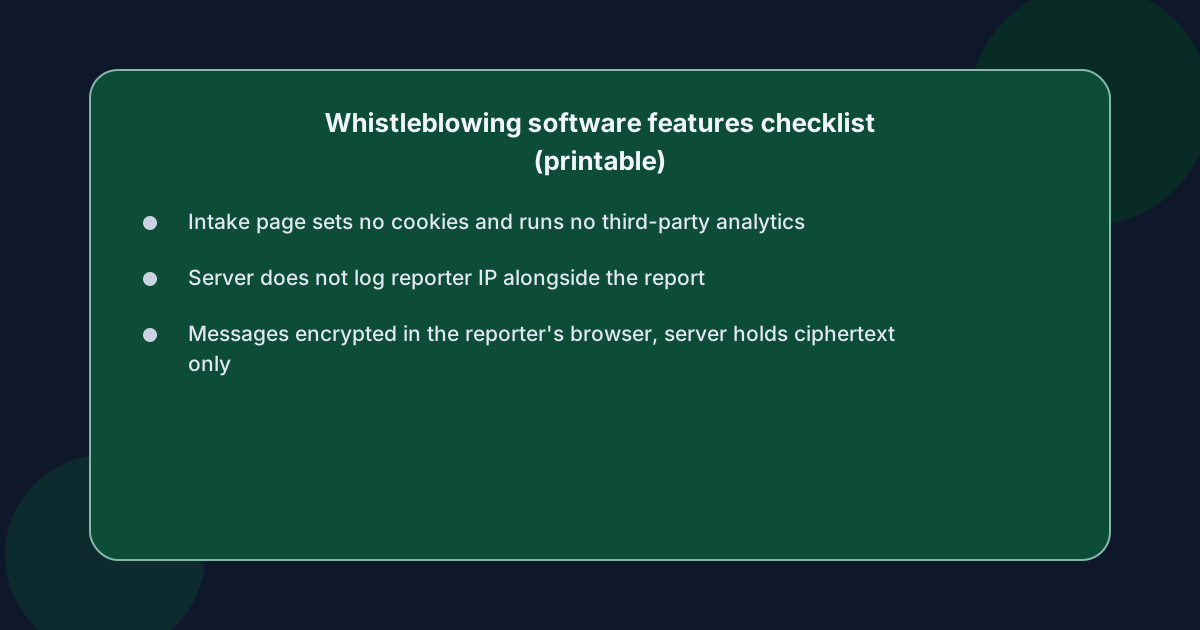 This is the checklist to bring to a vendor call. Print it, tick the boxes on the call, and ignore any vendor that hedges on more than two of them.
- Intake page sets no cookies and runs no third-party analytics
- Server does not log reporter IP alongside the report
- Messages encrypted in the reporter's browser, server holds ciphertext only
- Anonymous two-way communication through a private link, no email required
- Per-case file with status, owner, and full activity history
- 7-day acknowledgement deadline counted and surfaced in the dashboard
- 3-month feedback deadline counted and surfaced in the dashboard
- Immutable — status changes cannot be silently deleted
- Export to CSV and structured PDF for audit
- Unlimited internal users on a flat fee
- ISO 27001-certified data center hosting in Europe (Switzerland is a common choice)
- GDPR-compliant data processing, with a DPA available on request
- Channel configured and published quickly, without a long professional-services engagement
- Public framework-by-framework compliance documentation
- No per-seat or per-report surcharge added at renewal
A vendor that ticks 13 of 15 is a real candidate. A vendor that ticks 9 of 15 is a project, not a product.
Frequently asked questions
How much does whistleblowing software cost for a small business?
A purpose-built mid-market platform for an EU small business can be priced in the low tens of euros per month on a flat-fee plan, with no per-seat or per-report surcharge., with no per-seat or per-report surcharge. Enterprise GRC suites start in the low five figures annually and rise with headcount, which is the wrong shape of cost for a 50-to-500-person company.
What features must a whistleblowing tool have to be EU-compliant?
It must support anonymous two-way communication, an immutable audit log of every action on a case, automatic tracking of the 7-day acknowledgement and 3-month feedback deadlines, and an export format the regulator or auditor will accept. Anything less than those four is a ticketing system with a privacy page.
Do small businesses in the EU really need a whistleblowing channel?
Yes — under Directive (EU) 2019/1937, any legal entity with 50 or more workers must operate an internal reporting channel, with very narrow exceptions. A serious complaint handled outside a compliant process exposes the company to fines and to a much harder problem: a regulator asking, in writing, why the channel did not exist.
How long does it take to set up a whistleblowing channel?
A privacy-first platform designed for SMEs is typically operational in a single afternoon of configuration: set up the intake page, add case workers, publish the URL. The first 30 days are about policy and rehearsal, not deployment; if a vendor is quoting a six-week rollout, the platform is the wrong shape.
Can a shared inbox replace a whistleblowing platform?
No. A shared inbox fails on anonymity — emails carry identifiers, headers and timestamps back to the sender — and it fails on the immutable audit log a serious complaint demands. It also fails on the 7-day and 3-month deadlines, because nothing in a shared inbox enforces them. A shared inbox is a workaround, not a channel.