
Oct 9, 2026
Whistleblowing Channel vs Shared Inbox: When Email Stops Working

A shared inbox feels like the cheapest, most familiar way to receive a whistleblowing report — until the first time a regulator asks who saw it, who replied, and whether the reporter stayed anonymous. That is the moment most EU SMEs begin weighing a real whistleblowing channel against the shared mailbox they have been running on, and the choice between a whistleblowing channel vs shared inbox stops being an internal preference and becomes a compliance decision.
Table of contents
- Key takeaways
- Why a shared inbox is the default at most SMEs
- Where email and spreadsheets quietly break compliance
- Anonymity: what a shared inbox actually exposes
- Audit trail: what an email folder does and does not record
- Deadline tracking: why the 7-day clock slips in practice
- Who else in the company sees the report (and shouldn't)
- When a shared inbox is still the right choice
- Migration checklist: moving from inbox to a real channel without losing trust
- Frequently asked questions
- Sources
Key takeaways
- The EU Whistleblowing Directive (Directive (EU) 2019/1937) sets two hard clocks — seven days to acknowledge receipt and three months to give feedback — which a shared inbox can miss by minutes.
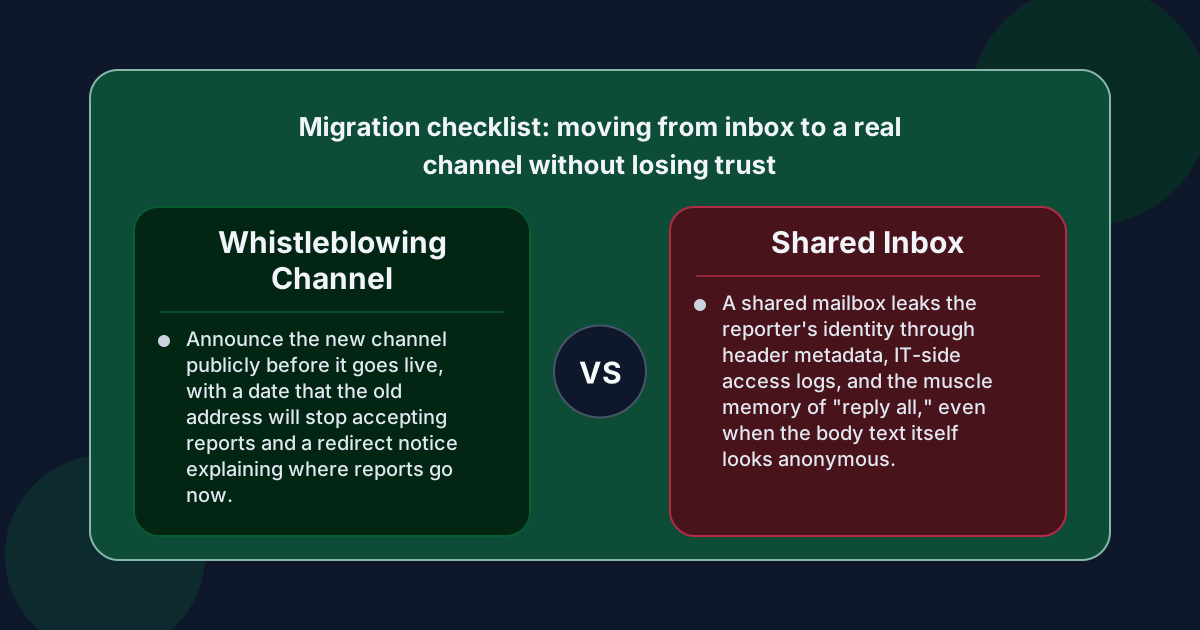
- A shared mailbox leaks the reporter's identity through header metadata, IT-side access logs, and the muscle memory of "reply all," even when the body text itself looks anonymous.
- Auditability under a shared inbox is a reconstruction exercise; under a purpose-built internal reporting channel it is a contemporaneous record.
- For very small, low-risk teams, a shared inbox can still be defensible — provided access is locked down, deadlines are tracked manually, and the channel is documented as a temporary measure.
- The migration from inbox to channel is mostly about trust: tell reporters early, keep the old address live for a handover period, and run both routes in parallel for at least one quarter.
Why a shared inbox is the default at most SMEs
A shared mailbox — usually a neutral alias like compliance@ or whistleblowing@ forwarding into an Outlook or Google Workspace inbox shared by HR, Legal and a trusted director — is what every growing company reaches for first because the cost is zero, the setup takes an afternoon, and the people who will handle reports are already inside the existing permission structure.
The same reasons explain why so many teams stay there: there is no new vendor to approve, no procurement question, no training curve, and the IT team does not have to open another console. In practice the inbox becomes the de facto whistleblower channel simply because nothing else has been set up.
That default holds until one of three things happens: a serious report lands, a regulator opens an inquiry, or a senior leader leaves and the access list becomes a forensic question. None of those three events are predictable, which is why the inbox is a reasonable starting point but a fragile long-term answer.
Where email and spreadsheets quietly break compliance
Email and the spreadsheets teams attach to it — a "whistleblower tracker" tab in Excel, a Trello card, a hand-written status column — were not designed for a process that has to satisfy seven-day and three-month legal clocks, an anonymity test, and an audit request that may arrive years after the report is closed.
The breakdowns are usually invisible day to day and obvious in retrospect. The reply goes out three days late because the assignee was on holiday and the rule was implicit. The audit trail is the email itself, which means it is whatever the people involved remember to keep. The status column on the spreadsheet drifts from "in review" to a colour nobody on the new team can decode.
Regulators do not grade on effort. They grade on outcomes: was the deadline kept, was the reporter's identity protected, can you prove it?
Anonymity: what a shared inbox actually exposes
Does a shared mailbox really break a reporter's anonymity?
Yes — almost always — because the identity leak happens in the infrastructure around the message, not in the words the reporter chooses.
Even when the body text says "I am writing anonymously," the email envelope carries the sender's IP address, the sending mail server, the client identifier in the headers, and the time stamp with sub-second precision. Anyone with shell access to the receiving server, anyone exporting mail logs, or anyone sitting in IT with administrator rights on the mail tenant can recover this — not by reading the report, but by reading the routing.
Once the message is in the inbox, the body itself yields more: writing style, internal vocabulary, the name of a project only three teams work on. Combined with metadata, that is often enough to identify the reporter even when nobody tried to. The shared mailbox also narrows the audience by accident: the moment a CC slips, or a colleague forwards the thread for "context," the audience grows without anyone making a deliberate choice.
A purpose-built channel treats anonymity as a property of the transport, not of the writer's discipline. End-to-end encryption in the reporter's browser, no cookies or fingerprinting on the report page, and a two-way reply path that uses a per-report link rather than an email thread are all ways of pushing the identity leak off the table. The anonymous reporting approach of those platforms is what the Directive's "confidentiality" requirement is really asking for in practice.
Audit trail: what an email folder does and does not record
An email thread records what was said, in what order, and by whom. It does not reliably record who saw the message, who opened an attachment, who deleted what, who changed the subject line, or whether a colleague was added to the shared mailbox on Tuesday and removed on Friday.
Those gaps are exactly the ones an auditor will ask about. A modern Security & GDPR Compliance posture expects an immutable activity log that timestamps every status change, every export, every assignment — not a recoverable history inside someone's mailbox. Platforms built for the job produce that record as a side effect of normal use; with email it is a separate project that someone has to remember to keep current.
When a regulator asks "who had access to this report and when," the answer from an inbox is "we think these five people, give or take the summer intern." From a purpose-built channel the answer is a tamper-evident export that an auditor can verify on the spot.
Deadline tracking: why the 7-day clock slips in practice
Article 9 of Directive (EU) 2019/1937 imposes two hard clocks on every member-state implementation: acknowledge receipt of the report within seven days, and give feedback on follow-up within three months. Both run from a single moment — the receipt of the report — and both have to be provable afterwards.
In a shared inbox, day one is the day the report arrived; day seven is whatever the calendar says seven days later, minus weekends if the team treats them as non-working, plus adjustments for the assignee being on leave. None of that is wrong in principle, but all of it is interpreted after the fact. That is what slips the clock in practice: not malice, not negligence, but a manager counting "business days" when the Directive counts calendar days, or a reminder buried under fifty other reminders.
A real channel treats the seven-day acknowledgment and the three-month feedback as first-class objects — visible to the case owner, surfaced on a dashboard, and kept in front of the case handler so they are not buried in a calendar. The way a small team gets this right without a platform is to log receipt in a single place the moment the report arrives, and own the deadline assignment to one named person rather than a mailbox.
Who else in the company sees the report (and shouldn't)
The defining feature of a shared mailbox is that the recipient list is editable. When a director goes on parental leave, IT adds the interim director. When a contractor needs to review a sensitive case, they get delegated access. Each of those changes is reasonable in isolation, and each of them widens the circle.
The Directive expects the opposite: a small, named circle, with every addition documented, and a structural separation between the people who configure the channel and the people who handle reports. In an inbox, that separation is whatever the IT team happened to set up. In a regulated channel, admin and case-worker roles keep settings and casework distinct by design.
This is the difference between "we believe only two people saw this" and "we can prove only two people saw this." Both are defensible — only one survives cross-examination.
When a shared inbox is still the right choice
A shared mailbox is not malpractice. It is defensible, in 2026, for a company with fewer than about 50 employees, no EU regulatory footprint beyond the local labour code, no sectoral whistleblowing obligations (no FINMA, no FCA, no Solvency II equivalent), and a named individual who is explicitly accountable for the channel. Under those conditions, an inbox with locked-down permissions, a documented access list, and a simple spreadsheet for deadlines can meet the directive's substantive obligations.
Three conditions make the inbox route work. The recipient list is hard-coded to two or three named individuals. A manual seven-day reminder is set in a calendar at the moment the report arrives. The mailbox is reviewed quarterly by someone outside the recipient list, who can answer "who saw what" without guessing.
When any of those conditions stops holding — the team grows past 50, a sectoral rule applies, a second person needs access for coverage — the inbox stops being a defensible channel and starts being a temporary one. The default assumption should be that an inbox is the first 18 months of a whistleblowing setup, not the last.
Migration checklist: moving from inbox to a real channel without losing trust
 The hardest part of replacing an inbox is not technical; it is the reporter who has used the old address once and never wants to set up a new account. A clean migration protects that trust.
- Announce the new channel publicly before it goes live, with a date that the old address will stop accepting reports and a redirect notice explaining where reports go now.
- Run both routes in parallel for at least one full quarter — keep the old mailbox live, auto-reply with the new link, and forward nothing.
- Document who had access to the old mailbox in a single page, signed by HR and IT, and archive the mailbox itself read-only for the statutory retention period.
- Brief the small set of people who previously handled reports on the new tool, including how the two-way reply works without exposing the reporter's identity.
- Map the open cases at cut-over: every report currently in flight gets a new case file with the original receipt date, so the seven-day and three-month clocks do not reset.
- Review the access list of every person who could read the old mailbox — and revoke what is no longer needed.
The migration is also a good moment to revisit the choice itself. For most teams moving beyond the smallest size, the manual effort of running an inbox as if it were a real channel costs more in HR time than a flat-fee platform. Looking at pricing sits naturally next to that question, because once the channel has to be defensible, the comparison is no longer technology versus technology but effort-hours per quarter versus a predictable monthly line.
For teams reaching that point, the practical route is to look at purpose-built platforms as one category among several — alongside the in-house rebuild, the legal-counsel hotline, and the industry-specific hotline — and to weigh each on the same four criteria: anonymity for the reporter, controllability of access, a contemporaneous audit trail, and a deadline engine that does not depend on a calendar reminder. Done that way, the choice stops being about email and starts being about which combination of those four properties the team can actually maintain.
Frequently asked questions
Is using a shared mailbox for whistleblowing reports illegal under EU law?
No. Directive (EU) 2019/1937 never names email or any specific technology; it sets requirements for anonymity, confidentiality, and follow-up that a shared mailbox can meet under narrow conditions. The directive becomes a problem for a shared inbox when anonymity, access control or deadline tracking slip — which in practice they tend to do as the team grows.
What are the main compliance risks of an email-based whistleblowing channel?
Header metadata leaks the reporter's identity even when the message text is careful, IT and mail-server administrators can read every incoming report, the access list drifts as people join and leave, and the seven-day acknowledgment and three-month feedback deadlines become calendar reminders rather than enforceable clocks. None of these is a single dramatic failure — they are slow leaks.
When should an SME move from a shared inbox to a dedicated whistleblowing tool?
The short answer is when the inbox stops fitting the way reports actually arrive: more than one person needs access for coverage, the team crosses fifty employees, a sector-specific rule begins to apply, or a serious report lands and the team realises the trail will not hold up. Before that point, a well-run shared mailbox can be a defensible interim channel.
How do I migrate reporters from a shared mailbox without losing them?
Tell them before the change happens, run both routes in parallel for a full quarter, redirect the old address to the new channel rather than killing it, and document who had access to the old mailbox so the historical record survives. The point is to keep the trust of the reporter who already used the channel once.
Do I need to keep the old whistleblowing mailbox after migration?
Yes — read-only, archived, for the retention period your member state requires for whistleblower records. Treat it as an evidence store, not a working inbox.