
Oct 18, 2026
Whistleblowing Channel for Remote and Hybrid Teams: A Practical Setup Guide

Most whistleblowing guides assume a desk, a shared inbox and a colleague two floors down. If your team is on five time zones, the design has to start somewhere else. Building a whistleblowing channel for remote teams means thinking about reach before thinking about form: a worker who logs in from a home network, a freelancer on a personal laptop and a contractor in a third country all need the same frictionless path to report what they have seen — without installing software, joining a VPN or creating an account that ties the report back to them.
Table of contents
- Key takeaways
- Why Remote and Hybrid Workforces Need a Different Whistleblowing Setup
- What the EU Whistleblowing Directive actually requires for distributed teams
- Who can file a report when there is no office and no shared inbox
- How to make the channel reachable without installing software or a VPN
- What an anonymous-by-default intake looks like for a remote reporter
- How to handle follow-up questions when the reporter is on a different continent and timezone
- Rolling the channel out to contractors, freelancers and partners across borders
- A 30-day rollout checklist for distributed teams
- Frequently asked questions
- Sources
Key takeaways
- The EU Whistleblowing Directive (Directive 2019/1937) applies to companies with 50 or more workers regardless of where those workers physically sit, so a distributed headcount is not a way out of the obligation.
- A remote-first intake has to be reachable from any browser, any network and any device — including personal ones — without an account, an app or a VPN.
- Anonymous by default is the only safe design for non-commercial installations: the reporter's identity must be protected even from the system itself, not just from colleagues.
- Time zones make the Directive's 7-day acknowledgment and 3-month feedback deadlines harder to miss, not easier — automated tracking beats a shared calendar.
- Contractors, freelancers and partner-channel reporters count as "workers" in several Member State transpositions; roll the channel out to them on day one, not later.
Why Remote and Hybrid Workforces Need a Different Whistleblowing Setup
A remote-first workforce breaks the assumptions an in-office whistleblower policy is built on. The traditional channel — a poster in the kitchen, a phone line on the reception desk, a manager in the next corridor — is invisible to someone working from a flat in Lisbon, a co-working space in Tallinn or a hotel in Berlin. When the office is optional, the channel has to be reachable without being there, and that changes every design choice that follows.
The second shift is trust. A reporter who has never met the compliance officer in person, who has only ever seen them on video, has less reason to believe a named report will stay confidential. That pushes the design toward anonymous reporting — not as a feature, but as the baseline. The third shift is operations: a case team spread across borders cannot rely on a tap on the shoulder or a quick hallway question, so the intake has to compensate with structured, asynchronous communication that does not depend on physical presence.
What the EU Whistleblowing Directive actually requires for distributed teams
Directive (EU) 2019/1937 requires legal entities with 50 or more workers, and certain public-sector bodies regardless of size, to operate an internal reporting channel that is accessible to "workers" — a term that covers employees, contractors, shareholders, board members, volunteers and, in many transpositions, suppliers. The Directive does not say "employees who report in person to an office"; it says workers, and the channel has to be reachable by all of them on equal terms. According to the EU Whistleblowing Directive page, the obligation applies to entities that meet the headcount threshold irrespective of how those workers are distributed across geographies.
Three concrete obligations matter most for distributed teams:
- Acknowledgment within seven days of receipt — counting every calendar day, including weekends, in any timezone the reporter writes from.
- Feedback within three months — a substantive response on what was done with the report, not a generic "we received your follow-up".
- Confidentiality of identity — the reporter's identity may not be disclosed to anyone beyond authorised handlers without their explicit consent, and the channel design has to make that technically true, not just policy-true.
Member States have transposed the Directive with national nuances. In Germany, the Hinweisgeberschutzgesetz (HinSchG) extends the personal scope to contractors and freelancers. In Spain, Ley 2/2023 covers self-employed workers and shareholders of listed companies. In Italy, the decree extends the scope to shareholders and members of administrative bodies. A multi-country reporting channel cannot rely on a single assumption: the safe path is to extend the channel to anyone who does work for the entity, including contractors.
Who can file a report when there is no office and no shared inbox
Is a freelancer in another country considered a "worker" under the Directive?
In several Member State transpositions, yes. Article 4 of Directive 2019/1937 defines "reporting persons" broadly, and most national implementations — including France's Loi Sapin II and Germany's HinSchG — bring at least some categories of contractors, freelancers and suppliers inside the personal scope. The safe reading is to open the channel to anyone who does work for or with the entity, including contractors.
The practical consequence is that an internal reporting channel is not the same thing as an employee hotline. It has to be reachable by a contractor who logs in once a quarter from a personal device, by a freelancer who never sees the company's intranet and by a partner-channel supplier who has never received a company email. If any of these groups is excluded — by requiring a corporate SSO login, an internal portal or a VPN connection — the channel fails the reach test that the Directive assumes. Resources designed for internal reporting channels tend to spell out who counts as a reporting person and how to reach them without an account.
How to make the channel reachable without installing software or a VPN
The default reach test is brutal: can a reporter, on a brand-new laptop, on a hotel Wi-Fi network, in any of the countries where the company operates, file a report in under three minutes, without installing anything, without creating an account and without a VPN? If the answer to any of those is no, the channel is not really reachable for a distributed workforce.
A remote-first intake strips the channel down to a browser page on a public URL. No app, no client, no corporate certificate, no IP allow-listing that breaks the moment the reporter moves. The page has to load without a CDN fingerprint that ties the visit to the company, set no advertising cookies and run no third-party analytics — those are the behaviours that make a reporter hesitate, and hesitation is what loses reports. For practical guidance on what anonymous reporting looks like in a browser-only setup, the patterns are well documented.
A second reach test is the personal device. A whistleblower working from a personal phone, a shared family tablet or a partner's laptop cannot be asked to install a corporate tool. The channel has to work from a private browsing window, leave no history the reporter has to clear later, and not prompt for permissions the reporter is not willing to grant. If the reporter has to install anything at all, the channel is failing the people it was built for.
What an anonymous-by-default intake looks like for a remote reporter
Anonymous by default means the reporter's name, email, phone number and IP address are never collected in the first place — not "collected and then protected", never collected at all. The intake form asks what happened, when, where and who was involved. It does not ask who is asking. If the reporter volunteers their name, that is a separate, explicit choice; if they do not, the system cannot tell.
The technical patterns that make this real are well established: encrypt the report body in the reporter's browser before it leaves the device, derive the key from a passphrase only the reporter knows, and store ciphertext on the server so even the operator cannot read the report. The reporter keeps a private link that works as their inbox; handlers reply through the same channel and the reporter is notified through that link, never by email tied to their identity. These are not exotic requirements — they are the baseline a whistleblowing channel for remote teams needs to meet before a single report is filed.
For reporters who would rather speak than type, voice reporting that transcribes audio on the reporter's device so the recording itself never has to be stored removes another reason not to report. The whole point of an anonymous-by-default intake is to lower the floor: if a reporter has to overcome five friction points before they can say what they saw, the channel is not anonymous, it is just inaccessible.
How to handle follow-up questions when the reporter is on a different continent and timezone
How does the 7-day deadline work when the reporter and the handler are 8 hours apart?
The Directive counts calendar days, not business hours, in the receiving entity's working time. The safe interpretation is to acknowledge within seven calendar days of receipt in any timezone, because the reporter's clock is what they experience. That means automated tracking beats a shared calendar: a deadline monitor that fires on day 5 and day 7 is far safer than a case worker remembering to reply.
The mechanics matter as much as the deadlines. Every follow-up question has to go through the same anonymous channel — never by email, never by phone to a number the reporter once gave. The reporter logs back in through their private link, sees the handler's question, and replies without ever revealing an inbox or a phone line. That two-way channel is the only safe way to ask "can you tell me more about the date?" without collapsing the anonymity the reporter chose.
For people operations and HR teams, this is where the practical setup for HR leaders starts to diverge from a generic ticketing workflow. A standard helpdesk assumes a known requester, a reply channel and an SLA measured in working hours. A whistleblower channel assumes none of those, and the tooling has to reflect it.
Rolling the channel out to contractors, freelancers and partners across borders
A multi-country reporting channel cannot stop at employees. Contractors, freelancers, suppliers, distributors, franchisees and partner-channel workers all count in several transpositions, and even where they are not legally covered, extending the channel to them is the safer choice. The rollout message has to reach each of these groups in the language they actually work in, on the device they actually use, with an explanation that does not assume prior knowledge of the company.
Three rollout mechanics tend to work:
- Pin the URL everywhere a worker might look: in the staff handbook, in onboarding packs for freelancers, in supplier portals, in the footer of internal newsletters, and in the public statement required under Article 13 of the Directive.
- Translate the intake into the working languages of each country, not just the official ones. A freelancer working in English for a German company needs the intake in English; the legal text on the page can stay in German.
- Train the handlers, not the reporters. Reporters do not need training; they need a URL. The case-handling team needs training on how to ask follow-up questions through an anonymous channel without breaking the reporter's cover.
The Directive's Article 13 also requires entities to provide a clear, accessible statement of the reporting procedure. For a distributed team, that statement lives on the same public page as the intake, not in a PDF buried in an intranet nobody visits.
A 30-day rollout checklist for distributed teams
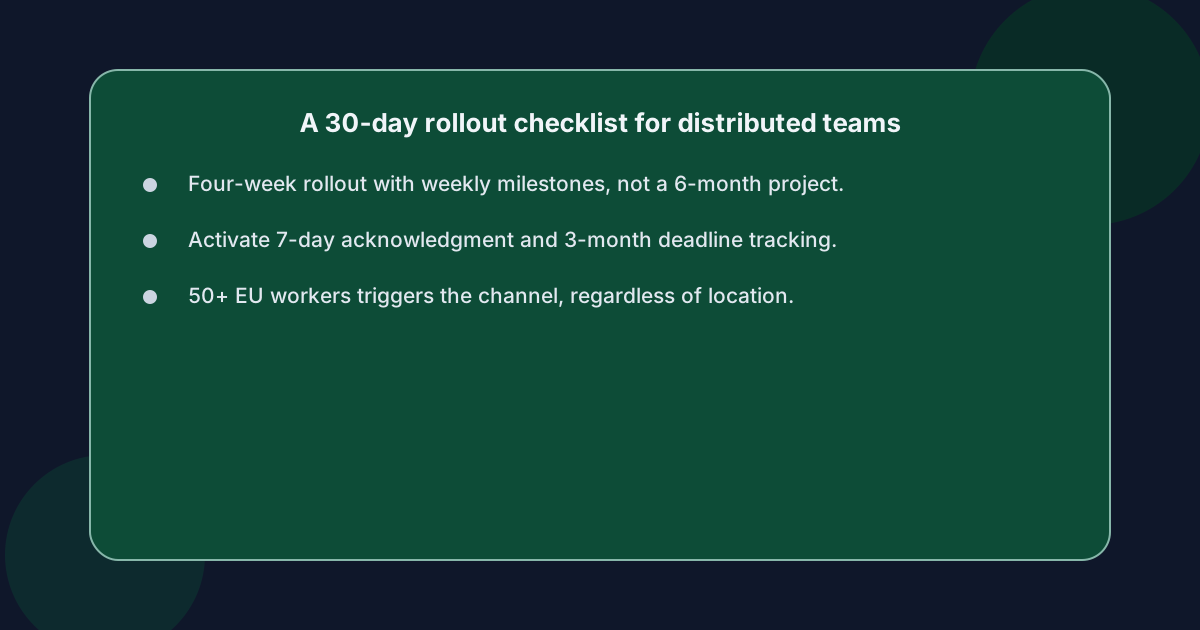 A 30-day rollout beats a 6-month project. The risk of waiting is that the obligation lands first; the risk of rushing is that the channel reaches the wrong people in the wrong way. The middle path is a four-week sprint with a clear set of milestones.
Week 1 — scope and policy. Confirm the headcount threshold (50+ workers across the EU, regardless of where they sit), list the countries where workers physically operate, and decide which categories beyond employees get access on day one (contractors, freelancers, suppliers, partners). Draft the remote employee whistleblowing policy in plain language, not legal language.
Week 2 — intake and handlers. Stand up the browser-based intake on a public URL, with anonymous-by-default data collection and per-report encryption. Pick two handlers (a primary and a backup) per region or timezone, train them on the channel's mechanics, and switch on automated 7-day and 3-month deadline tracking.
Week 3 — multilingual reach. Translate the intake page and the policy statement into every working language in the team. Publish the channel URL in every place a worker might look (handbook, onboarding, supplier portal, intranet footer, public statement). Confirm reach from a personal device on a non-corporate network without a VPN.
Week 4 — go-live and audit trail. Open the public reporting page, file a test report through the reporter's flow, walk the 7-day acknowledgment and a follow-up reply, then export the audit log for the first internal review. Set a recurring quarterly review of handler training and a yearly review of the policy text itself.
A 30-day rollout is realistic when the tooling does most of the hard work. For teams that want a ready-made starting point, ashio's pricing lays out the feature set without an enterprise sales motion — though for organisations above the SME bracket, or those that need on-premise deployment, it is not the right fit and a heavier GRC suite may be the better match.
Frequently asked questions
Does the EU Whistleblowing Directive apply if my team is fully remote?
Yes. Directive (EU) 2019/1937 applies to legal entities with 50 or more workers, regardless of where those workers physically sit. A distributed headcount across five EU countries still counts toward the threshold; the Directive's personal scope follows the workers, not the office.
Can a reporter stay anonymous if they file from a personal device on a home network?
Yes, if the channel is designed for it. An anonymous-by-default intake collects no account, no email and no IP address; encrypts the report in the reporter's browser; and never sets cookies or runs analytics on the report page. The reporter returns through a private link, not through a login.
Do contractors and freelancers count as reporting persons under the Directive?
In most Member State transpositions, at least some categories do. Article 4 of the Directive defines reporting persons broadly, and national laws in France, Germany, Spain and Italy extend coverage to contractors, freelancers, suppliers and, in some cases, shareholders. The safe path is to open the channel to anyone who does work for the entity.
How do I handle follow-up questions across time zones without breaking anonymity?
All follow-up goes through the same anonymous channel: the handler replies through the case file, the reporter is notified through their private link, and the exchange never touches email or phone. Automated tracking of the 7-day acknowledgment and 3-month feedback deadlines keeps the SLA honest across time zones.
What is the safest way to publish the channel URL to a distributed team?
Put it in every place a worker might already look — the staff handbook, the onboarding pack for freelancers, the supplier portal, the internal newsletter footer and the public statement required under Article 13 of the Directive. Translate it into the working languages of each country, not just the official ones, and confirm it loads from a personal device on a non-corporate network without a VPN.