
Nov 2, 2026
Whistleblowing Software for Startups: What You Actually Need (and What You Can Skip)

Most startups overbuy whistleblowing software or dangerously underuse a free inbox. For a 20–80-person company, whistleblowing software for startups is usually worthwhile when it provides anonymous intake, secure two-way communication, case tracking, and evidence of a functioning reporting process—not because a larger organization needs a complex compliance suite.
The practical question is which capabilities are essential, which can wait, and what the total cost should include.
Table of contents
- Key takeaways
- Does a startup actually need dedicated whistleblowing software, or is a shared inbox enough?
- Which whistleblowing features are essential vs. nice-to-have for a 20–80 person company?
- How should a startup evaluate whistleblowing vendors on anonymity, hosting, and contract length?
- What does compliant whistleblowing software realistically cost a small startup in 2026?
- How to roll out a whistleblowing channel in a startup without spooking the team
- Frequently asked questions
- Sources
Key takeaways
- A shared inbox may be enough for initial intake, but it is weak at preserving reporter anonymity and separating confidential communications from routine business email.
- The core requirements are anonymous reporting, secure communication, controlled access, case records, deadline monitoring, and an audit trail.
- Compare vendors on technical architecture, hosting location, data processing terms, contract length, and exit arrangements—not just the monthly price.
- When evaluating compliant whistleblowing software, a small startup should compare the subscription, implementation, training, and internal administration costs for the scope it actually needs.
- A rollout succeeds when employees understand what can be reported, how anonymity works, and what happens after someone submits a report.
Does a startup actually need dedicated whistleblowing software, or is a shared inbox enough?
A startup can use a shared inbox for basic intake, but it is rarely the best long-term whistleblowing channel once the company has employees, managers, and confidential matters that may need to be investigated.
The limitation is not convenience; it is confidentiality. A standard email account can expose metadata, may retain messages in other systems, and requires access to be shared among administrators and investigators. It also makes it harder to demonstrate that a reporter can remain anonymous while receiving follow-up questions.
A shared inbox is acceptable for early-stage preparation, not as the default confidential reporting route. A founder or operations lead may use one temporarily while assessing the appropriate process, but reports about serious misconduct should not be mixed into ordinary customer, recruitment, or finance correspondence.
Dedicated software becomes more useful when a startup needs any of the following:
- A reporting page that does not require an account.
- A private way for a reporter and investigator to exchange messages.
- Clearly separated access for administrators and case handlers.
- A case record containing notes, status, ownership, and communications.
- Tracking of acknowledgment and feedback deadlines.
- An activity log that supports governance reviews and compliance audits.
The legal context also matters. Under Directive (EU) 2019/1937, covered organizations must establish internal reporting channels for certain categories of persons, including workers and self-employed individuals. GDPR also governs personal data processed through the channel, including reports and information about the reporter.
A useful first step is to determine whether the startup falls within the directive’s scope and which sectors or national rules add requirements. The question of whether your company needs a whistleblowing channel should consider headcount, organizational structure, risk environment, and legal obligations—not company age alone.
Which whistleblowing features are essential vs. nice-to-have for a 20–80 person company?
The essential feature set for a 20–80-person company is anonymity, confidential communication, controlled access, structured case handling, deadline visibility, and an audit trail. Everything else should be justified by a specific operating or compliance need.
What should a startup whistleblowing channel do at minimum?
A minimum viable reporting channel should meet six requirements:
- Anonymous intake: Reporters can submit information without creating a conventional account.
- Secure two-way communication: Investigators can ask questions and receive answers without exposing the reporter’s identity.
- Access separation: Administrative permissions should be distinct from case-handling access.
- Case management: Each report needs a status, owner, notes, and recorded actions.
- Deadline monitoring: Acknowledgment and feedback obligations remain visible throughout the case.
- Audit-ready records: Activity can be reconstructed without exposing report content to the platform operator.
These controls correspond with the whistleblowing software requirements checklist, which is useful for separating mandatory requirements from optional functionality.
The EU directive sets a 7-day acknowledgment period and a reasonable period of no more than three months for feedback to the person who made a report, unless there is a justified reason for delay. Those deadlines should therefore be visible in the workflow rather than dependent on an investigator remembering them.
Which features can wait?
Nice-to-have features are not automatically valuable at startup scale. Complex dashboards, extensive workflow configuration, advanced analytics, and broad integrations should wait until a real requirement justifies their cost or administration.
For example, a 25-person company may have little need for elaborate escalation hierarchies or a large reporting taxonomy. It may need something simpler: a clear submission form, a defined case owner, controlled access, and dependable records.
Voice intake is useful when writing is a genuine barrier, but it is not a substitute for basic text-based reporting. Likewise, unlimited team members may not matter at first if only two or three people need access. Evaluate optional features against anticipated report volume, workforce literacy, accessibility needs, and the organization’s internal controls.
A useful whistleblowing software features comparison should show what protects the reporting process, not merely how many controls appear in a vendor’s feature list.
How should a startup evaluate whistleblowing vendors on anonymity, hosting, and contract length?
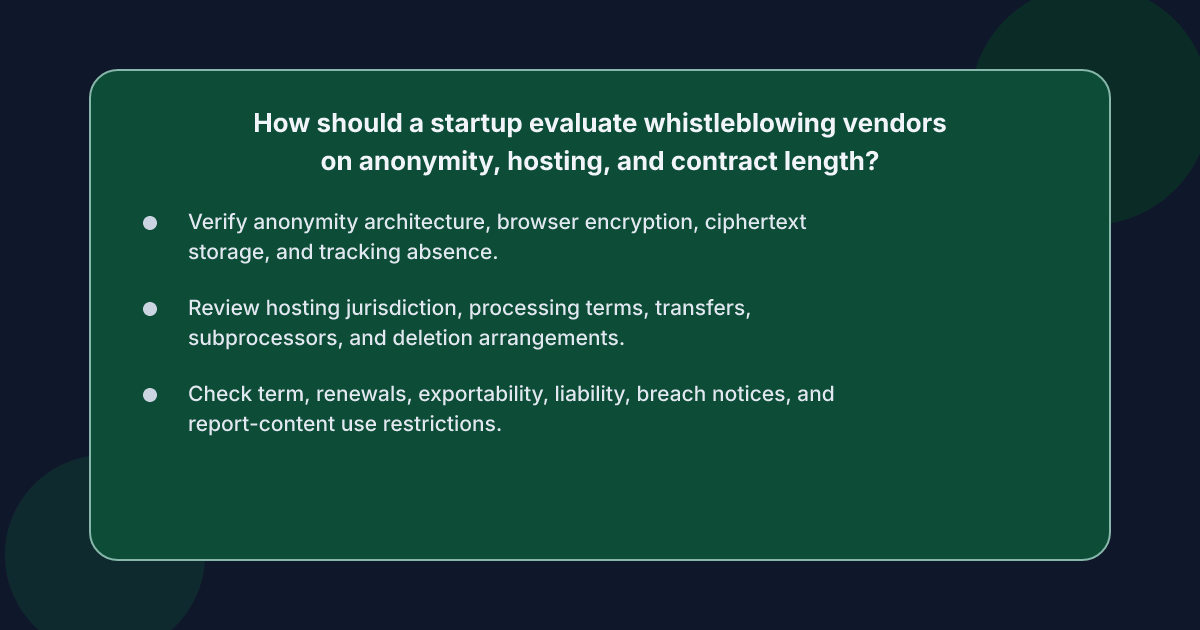 A startup should evaluate vendors on the protection of the reporting process, the handling of personal data, operational fit, and contractual flexibility. The lowest sticker price is often less important than whether the system can preserve anonymity and support defensible investigation.
How can a startup verify a vendor’s anonymity claims?
Ask how anonymity is achieved, who can decrypt report content, and what data is generated when a reporter opens or submits a report. A credible answer should distinguish identity from the content of the report rather than relying on a vague promise of confidentiality.
Pay particular attention to technical controls such as encryption in the browser, storage of ciphertext rather than readable content, and the absence of cookies, analytics, or fingerprinting on reporting pages. The security documentation for ashio describes end-to-end encryption in the browser, per-report encryption keys, zero-access architecture, and reporting pages without cookies, analytics, or fingerprinting.
It is also reasonable to ask whether the vendor can explain its architecture in plain language and provide supporting documentation. Marketing language such as “anonymous” or “encrypted” is not enough; the startup should understand which party can access report content and under what conditions.
Does hosting location matter?
Hosting location can matter because data-protection obligations follow the organization’s regulatory context, not merely the country where a server happens to be located. If the startup operates in the EU, it should assess the provider’s processing terms, transfer mechanisms, subprocessors, and deletion arrangements.
Swiss hosting may be relevant to organizations with Swiss operations or data-protection requirements. Ashio states that its systems run in ISO 27001-certified, carbon-neutral data centers in Switzerland, while its knowledge base provides compliance and security documentation for review.
What should a startup check before signing?
Evaluate the contract for:
- The minimum term and renewal mechanism.
- Notice periods for price increases.
- Data export formats.
- Deletion deadlines after termination.
- Subprocessor and data-location disclosures.
- Liability and breach-notification provisions.
- Whether reporting content is excluded from the provider’s own processing purposes.
Avoid long commitments made without understanding migration and exit arrangements. Ask for a sample export, review the complete data-processing documentation, and establish who at the startup will own the system.
What does compliant whistleblowing software realistically cost a small startup in 2026?
A small startup should expect an affordable whistleblowing tool to cost materially less than a traditional enterprise governance suite, but the realistic 2026 budget depends on scope, team size, hosting model, and contractual terms.
Market prices vary with the scope of the channel, deployment model, and contractual terms, so a startup should compare vendors using the same requirements and obtain current quotations.
Ashio’s published pricing information lists a Basic option at €29 per month, with annual billing saving 20%, and a free 14-day trial with no credit card required. That range illustrates why a startup should distinguish a straightforward internal channel from a more complex enterprise deployment.
The comparison should include all relevant costs:
- Monthly subscription or annual commitment.
- Additional modules or services.
- Implementation and onboarding.
- Internal labor for configuration and staff training.
- Legal review of policies and data-processing terms.
- Integration or migration work.
- Renewal increases and minimum contract exposure.
For a 20–80-person company, the key threshold is not a particular vendor’s price but whether the total annual cost is proportionate to the risk and administrative effort involved. Compare options using the same scope and ask each supplier to explain what is excluded.
Avoid comparing a basic internal reporting channel with a full enterprise governance platform. Such a whistleblowing software features comparison can make inexpensive products appear incomplete and expensive products appear unnecessarily capable. Build a weighted requirements list, test the highest-risk workflows, and treat hosting, encryption, auditability, and contractual exit terms as core criteria rather than optional extras.
How to roll out a whistleblowing channel in a startup without spooking the team
A successful whistleblowing rollout for a startup combines a clear internal policy, visible communication, a short training message, and a controlled review of the first cases. The aim is to make the channel understandable, not to portray the organization as inherently suspicious.
What should a startup communicate internally?
Explain what the channel is for, who may use it, whether reports can be submitted anonymously, and what happens after a report arrives. Also explain what the channel cannot be used for, such as ordinary customer support or disputes that should follow another established process.
The communication should be factual. Avoid framing the new channel as evidence of serious misconduct or promising that every report will produce an immediate investigation. A clear statement of confidentiality, impartial handling, and escalation to appropriate authorities is more credible than sweeping guarantees.
What should be ready before launch?
A practical startup whistleblowing rollout follows six steps:
- Confirm legal scope and document the responsible internal policy.
- Assign a policy owner and at least one alternate case handler.
- Configure access permissions and reporting categories.
- Test anonymous submission, messaging, escalation, and reporting deadlines.
- Train managers on how to receive and refer disclosures.
- Publish the channel through trusted internal communication channels.
Test the process before announcing it. Confirm that a reporter can submit a test report, receive a follow-up question, reply privately, and see the correct acknowledgment deadline. The small-business whistleblowing software checklist can help ensure that operational details are covered before launch.
Managers also need guidance on what to do when someone discloses misconduct informally. They should listen, avoid making promises they cannot keep, prevent unnecessary discussion, and direct the person to the appropriate reporting route.
Frequently asked questions
Do startups have to buy whistleblowing software?
Not every startup must purchase dedicated software, but covered organizations may be legally required to provide an internal reporting channel. A shared inbox or other established channel may meet some needs, but it must protect confidentiality, support communication with the reporter, and enable effective follow-up.
What is the cheapest acceptable whistleblowing channel for a small business?
The lowest-cost option is not necessarily the safest option. A small business should prioritize anonymous intake, secure two-way communication, controlled access, case records, deadline tracking, and a defensible audit trail; optional analytics and advanced configuration can usually wait.
Is email safe for confidential whistleblowing reports?
Ordinary email is generally a weak substitute for a dedicated reporting system because it can expose metadata, distribute access more broadly than necessary, and complicate deletion or audit controls. It can serve as a temporary intake route, but confidential reports should move into a controlled process promptly.
How long should a startup whistleblowing software contract be?
Choose the shortest term that reflects the company’s implementation and budget plans, while checking renewal dates, price-adjustment terms, data-export rights, deletion obligations, and exit procedures. A long contract is harder to justify when the startup’s headcount and reporting requirements may change quickly.
Can whistleblowing software prevent retaliation?
No software can guarantee that every allegation is genuine or that no misconduct will occur. It can reduce reporting friction, preserve the separation of the reporting process, document access and actions, and make it easier to investigate concerns consistently.