
Oct 26, 2026
Whistleblower Retaliation: How to Prevent It and What to Do When It Happens

Retaliation complaints escalate quickly because they often appear alongside an underlying grievance, personnel dispute, or investigation. Effective whistleblower retaliation prevention therefore requires two parallel systems: controls that reduce the risk before a report arrives, and a structured HR response that protects the reporter without prejudging the allegations.
Table of contents
- Key takeaways
- What counts as retaliation against a whistleblower under the EU Directive?
- How can employers prevent retaliation before a report is ever filed?
- What should HR do in the first 48 hours after a retaliation complaint?
- Which protective measures should be applied during an active investigation?
- How do you document anti-retaliation steps so they hold up in an audit or claim?
- Frequently asked questions
- Sources
Key takeaways
- Retaliation can include harmful conduct, actions, omissions, or attempted retaliation against people who report or participate in an investigation.
- EU Directive 2019/1937 requires effective protection for whistleblowers, including measures that prevent retaliation and provide support.
- HR should acknowledge the complaint, separate the personnel issue from the investigation, and preserve evidence during the first 48 hours.
- Protective measures must be proportionate, documented, and reviewed as the investigation develops.
- A defensible employer record shows what decision-makers knew, when they acted, and why each protective measure was chosen.
What counts as retaliation against a whistleblower under the EU Directive?
Retaliation against a whistleblower includes any adverse treatment, threatened treatment, omission, or attempted adverse treatment connected with a report, disclosure, or investigation participation. The connection can be direct, but it can also arise from circumstances suggesting that the whistleblower was treated differently because of protected activity.
The EU Whistleblowing Directive establishes anti-retaliation duties in Articles 19 and 20. These provisions require proportionate and effective protection against retaliation, including protection for colleagues who assist with investigations. Directive 2019/1937 also requires Member States to provide legal remedies and administrative penalties for retaliation, although the precise rules vary by jurisdiction.
Potential retaliatory conduct includes:
- Dismissal, redundancy, suspension, demotion, or loss of responsibilities.
- Reduced hours, unfavorable scheduling, withheld opportunities, or removal from projects.
- Negative references, unjustified poor performance assessments, or disciplinary warnings.
- Harassment, intimidation, hostile conduct, or deliberate isolation.
- Changes to duties or location without a legitimate operational reason.
- Withholding information or resources needed to perform the person’s role.
- Attempts to discourage reporting or participating in an investigation.
Timing alone does not prove retaliation. A management decision may be entirely legitimate, but it becomes vulnerable to scrutiny if the decision-maker knew about protected activity and the timing, treatment, and stated reasons appear inconsistent.
Does criticism of a whistleblower count as retaliation?
Criticism can become retaliation when it is unsubstantiated, disproportionate, public, or connected to protected reporting. A legitimate performance concern may still require scrutiny if the same conduct was tolerated from other employees.
HR should compare the alleged retaliatory act with the treatment of comparable employees, examine whether relevant procedures were followed, and preserve the original performance evidence. For more on the employment-law context, including worker rights in Germany.
How can employers prevent retaliation before a report is ever filed?
Organizations reduce retaliation risk by making protection part of ordinary governance rather than waiting for a complaint. The prevention framework should cover visible leadership behavior, accessible reporting channels, independent escalation routes, and a clear anti-retaliation policy.
Which prevention controls matter most?
The most effective controls address how employees view the reporting process, how cases are assigned, and who has authority to make employment decisions.
- State that retaliation is prohibited in the whistleblowing policy.
- Define protected activity, covered reports, and examples of prohibited conduct.
- Provide confidential and anonymous reporting routes.
- Explain how reports are assessed and handled without revealing unnecessary personal data.
- Separate report intake from decisions about the reporter’s employment.
- Give HR and compliance teams escalation criteria and response times.
- Require documented approval for adverse actions involving people connected to an investigation.
- Review retaliation patterns, near misses, and closed cases periodically.
Management must also model the required behavior. If senior leaders dismiss concerns, imply that reporting will cause trouble, or discuss confidential case details, formal policy language will not correct the culture.
How should the reporting channel be designed?
An accessible reporting channel should work without unnecessary technical complexity and should not expose a reporter to routine internal communications. Employees need to understand what happens after submission, who reviews the matter, and what protections apply.
For organizations comparing manual processes with purpose-built tools, Ashio provides anonymous intake, two-way communication, deadline monitoring, and structured case management. It is intended for organizations that need a reporting channel without enterprise-wide compliance software or per-seat billing, and should be assessed against the investigation functionality an organization requires.
The HR leaders’ guidance can help teams translate whistleblower duties into internal responsibilities and procedures.
What should HR do in the first 48 hours after a retaliation complaint?
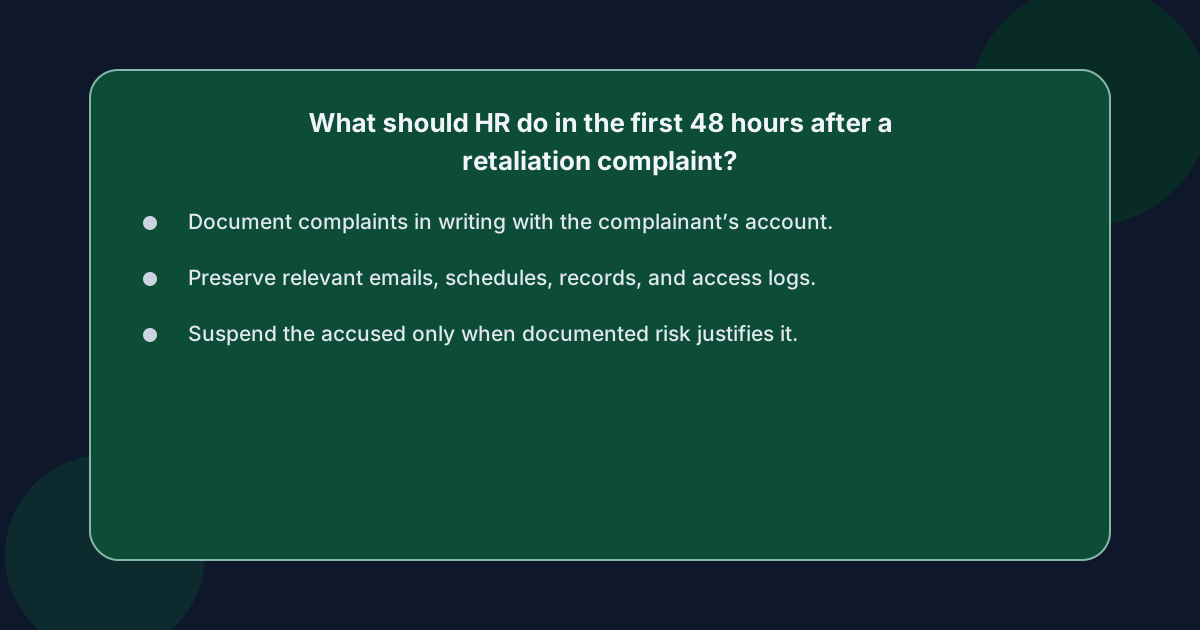 During the first 48 hours, HR should acknowledge the complaint, preserve relevant evidence, prevent escalation where practicable, and establish an investigation team with defined authority. Speed matters because overlooked changes to duties, schedules, access, or records can damage both the reporter and the employer’s defense.
What should happen immediately after HR receives the complaint?
The initial response should be factual, nonjudgmental, and carefully recorded. HR should confirm receipt, identify immediate safety or ongoing-deterrence concerns, and clarify that the person will not face adverse treatment for making a protected report.
In the first 48 hours:
- Record the complainant’s account, requested remedy, and any immediate risk.
- Acknowledge the complaint in writing and explain the next procedural step.
- Identify and preserve emails, messages, schedules, performance records, and access logs.
- Ask managers not to alter the complainant’s duties or conditions without a documented reason.
- Screen for conflicts between decision-makers and the reporter or alleged wrongdoer.
- Decide whether interim separation is necessary and proportionate.
- Record who knew about the complaint and when.
Managers should not promise a particular outcome. They can explain that the concern will be assessed independently and that the employee will receive opportunities to respond before adverse conclusions are reached.
Should HR suspend the accused employee immediately?
No. Suspension is not an automatic response and can itself become part of a retaliation claim. The decision should follow a risk assessment, especially where a move would affect pay, seniority, reputation, access, or the employee’s ability to work.
A defensible interim decision considers the seriousness of the alleged conduct, the evidence available at that stage, operational disruption, and less intrusive alternatives. The reasons should be recorded, reviewed regularly, and communicated without implying guilt.
Which protective measures should be applied during an active investigation?
Protective measures in a whistleblower investigation should reduce the risk of retaliation or interference while preserving normal work, confidentiality, and the right to a fair process. They should be tailored to the facts because excessive controls can themselves become discriminatory.
How should HR choose protective measures?
The appropriate response depends on the alleged retaliatory conduct, the employer’s control over the relevant decision, and whether the risk is continuing or merely theoretical. Protective measures are strongest when they are targeted, time-limited, and linked to a documented risk.
Possible measures include:
- Changing reporting lines or decision authority.
- Removing a person from decisions about the reporter’s performance.
- Restricting access to confidential investigation material.
- Adjusting schedules, duties, or work locations where justified.
- Assigning an independent contact for questions from the reporter.
- Recording and approving external communications about the investigation.
- Requiring that adverse decisions are reviewed before implementation.
- Providing temporary support where harassment, safety, or severe stress is alleged.
The operating guidance on works councils and employee involvement is also relevant where national law requires consultation or coordinated involvement.
What must remain protected?
Measures must not compromise confidentiality, equality, or due process. The reporter should not be required to disclose more personal information than necessary. The person against whom an allegation is made must still receive a fair opportunity to respond, and witnesses should be protected against intimidation and unnecessary disclosure.
Each measure should identify its purpose, owner, duration, review date, and any conditions for lifting it. A measure that lacks an owner or review date is unlikely to provide reliable protection.
How do you document anti-retaliation steps so they hold up in an audit or claim?
Documenting anti-retaliation steps creates a contemporaneous record of what the employer knew, what it did, and why its response was reasonable. The record should connect preventive policy, complaint handling, interim decisions, and the final outcome.
What records should HR retain?
A complete file should contain the policy version in force at the time, channels provided to employees, the original complaint, assessment decisions, interview records, evidence-preservation notes, protective-measure decisions, communications, and the final findings.
Each material decision should answer five questions:
- What fact or event triggered the decision?
- Who made the decision?
- Which policy, procedure, or legal duty supported it?
- What alternatives were considered?
- When will the decision be reviewed?
Documenting anti-retaliation steps should distinguish fact from inference. Use neutral wording, date every entry, identify the author, and preserve original records rather than rewriting them.
How can an employer defend the claim fairly?
A retaliation claim defense depends on a credible, consistent record rather than a general assertion that the employer acted reasonably. The employer should be able to show that legitimate employment decisions would have been made in the same way regardless of protected activity.
Useful evidence includes comparative treatment, documented performance processes, approval records, policy acknowledgements, investigation notes, and evidence that decisions were independently reviewed. The organization should also preserve adverse evidence and inconsistencies; selectively omitting unfavorable material weakens credibility.
HR should separate findings about retaliation from findings about the original report. A reporter may fail to prove the underlying allegation and still experience unlawful treatment because of protected activity. The knowledge base and compliance documentation provides reference material for mapping reporting processes to compliance frameworks.
Frequently asked questions
Is every adverse employment decision against a whistleblower retaliation?
No. Retaliation requires a connection between the adverse treatment and protected activity, although that connection does not always have to be explicitly acknowledged by the decision-maker. HR should examine timing, treatment of comparable employees, procedural consistency, and contemporaneous documentation before reaching a conclusion.
Can a report be investigated anonymously and still support a retaliation claim?
Yes. Anonymity can make protected reporting more accessible, but it does not prevent an employer from assessing retaliation. Relevant evidence may come from other witnesses, management records, system logs, performance documentation, or information voluntarily provided by the complainant.
How long should an employer retain anti-retaliation records?
Retention periods depend on national employment, privacy, and whistleblowing law, as well as limitation periods for relevant claims. Organizations should set a documented retention schedule that covers the full period in which a case may be challenged, rather than deleting records when an internal investigation closes.
Should HR inform the accused person that a retaliation complaint has been made?
HR should provide enough information to allow a fair response while avoiding unnecessary disclosure that could identify the complainant or compromise the investigation. The necessary level of detail should be assessed under the applicable legal framework and the organization’s confidentiality rules.