
Nov 9, 2026
Whistleblowing Channel Audit Checklist: 12 Things to Test

An audit-ready reporting channel must do more than receive reports. A whistleblowing channel audit should test the complete operating chain—from anonymous intake and two-way communication to deadlines, case decisions, and documented closure—while identifying weak controls before a formal review. This whistleblowing audit checklist gives compliance, legal, HR, operations, and procurement teams a practical way to assess the channel, evidence its effectiveness, and plan remediation.
Table of contents
- Key takeaways
- What Should a Whistleblowing Channel Audit Cover?
- Checklist 1–4: Intake, Reporter Privacy, and Communications
- Checklist 5–8: Case Ownership, Feedback, and Escalation
- Checklist 9–12: Deadlines, Records, Access, and Closure Evidence?
- How to Score Findings and Assign Remediation Actions
- What Evidence Should You Retain After the Audit?
- Frequently asked questions
- Sources
Key takeaways
- Test all 12 controls as an operating chain; a secure intake form alone does not prove that reports are handled consistently.
- Verify that reporter privacy protects anonymity across the public form, follow-up messages, records, and access permissions.
- Confirm that every report has an owner, status, acknowledgement, feedback decision, and documented closure.
- Treat deadlines and retained evidence as separate controls: timely action and complete documentation are equally necessary.
- Record each audit finding with an owner, severity, corrective action, target date, and verification evidence.
What Should a Whistleblowing Channel Audit Cover?
A whistleblowing channel audit should assess whether the reporting channel works as designed, protects reporters, meets applicable legal deadlines, and produces a defensible audit trail. The assessment must cover the full case lifecycle rather than only the submission form.
A useful whistleblowing compliance audit separates four control areas:
- Intake: Can a reporter submit a report without creating unnecessary identifying information?
- Communication: Can the organisation ask follow-up questions and receive answers without undermining confidentiality?
- Case handling: Is each report assigned, assessed, investigated, and decided consistently?
- Governance: Are deadlines, records, access rights, escalation routes, and closure evidence documented?
The exact scope depends on the organisation, applicable national law, internal policy, and any sector-specific requirements. For EU organisations, the EU Whistleblowing Directive is a useful starting point, but national implementing laws may add or clarify obligations.
The audit should also distinguish between the design of the channel and its operation in live cases. A policy may state that reports are acknowledged within seven days while the actual system or working practice does not enforce or evidence that step. A reporting channel assessment should combine document review, process walkthroughs, record sampling, access testing, and interviews with the people responsible for handling reports.
Checklist 1–4: Intake, Reporter Privacy, and Communications
The first four checks establish whether a potential reporter can submit information safely and whether the channel supports confidential communication throughout the case.
Can a reporter submit a report without being unnecessarily identified?
The intake form should not request information that the organisation does not need to assess and investigate a concern. Review whether it asks only for relevant details, permits anonymous submission, and makes optional fields clearly optional.
For an anonymous reporting audit, inspect the form, the public-facing page, network-related settings, and the resulting case record. The important question is not simply whether the form has no name field. It is whether the complete submission process avoids unnecessary technical or behavioural data that could reveal the reporter’s identity.
Does the channel prevent avoidable identifying information from entering the case?
Review sample reports for accidental identifiers, including names, email addresses, telephone numbers, document metadata, distinctive wording, and details that could narrow down the author’s identity.
Controls should address both intentional submission and later analysis. If the receiving team proposes redaction, make sure the process is documented, proportionate, and supported by appropriate access restrictions. The anonymous reporting guidance provides further considerations for evaluating reporter privacy.
Can follow-up questions protect the reporter’s confidentiality?
Test the complete communication path. A handler should be able to send a follow-up question, receive the reporter’s response, and associate both with the correct case without exposing unnecessary identity information.
Record the questions asked, responses received, dates, and handling of unanswered requests. The process should also define what happens when a reporter does not respond. Case closure may still be appropriate, but it should follow a documented decision rule rather than happen automatically because the system remained inactive.
Can reporters and handlers distinguish the genuine channel from impersonation?
Assess how the organisation communicates with reporters and how authenticity is established without collecting identity data unnecessarily. Anonymity should not be replaced by insecure practices such as sending sensitive details through ordinary email, adding metadata to outbound files, or asking reporters to authenticate through an exposed personal account.
Review internal procedures for handling requests, attachments, links, and follow-up exchanges. The objective is to preserve confidentiality and traceability without creating a record that reveals the reporter’s identity.
For organisations building or reviewing these controls, the security architecture should be assessed alongside internal procedures, because operating rules cannot compensate for unsafe technical design.
Checklist 5–8: Case Ownership, Feedback, and Escalation
The next four checks determine whether incoming reports move through a disciplined case-handling process with clear accountability and documented decisions.
Does every report have an accountable owner and current status?
Select a sample of open and closed cases. Confirm that each report has a named owner, a current status, and a record of all material actions. The owner should know what decisions are required and which deadlines apply.
“Everyone handles reports” is not an ownership model. The assessment should identify who can review, decide, approve closure, grant access, and handle conflicts of interest. For larger teams, delegation and absence arrangements should also be visible.
Are preliminary assessments consistent and proportionate?
Test whether reviewers apply a common approach to relevance, seriousness, conflicts of interest, and the need for further information. The case file should show why the organisation decided to proceed, request more information, refer the matter, or close it.
A sound whistleblowing controls framework distinguishes triage from investigation. It does not require every concern to trigger the same process, but it does require the selected route and its rationale to be recorded.
Does the organisation provide feedback within the required period?
Directive (EU) 2019/1937 requires feedback to the reporter within a reasonable period, generally no later than three months after receipt of the report, while allowing that period to be extended where the nature and complexity of the report or the related investigation justify it. Test whether the case record shows what feedback was provided, when it was sent, and whether the reporter received an appropriate explanation.
Where more time is needed, the organisation should record the reason and keep the reporter informed as appropriate. A missed deadline should be investigated as an operating failure, not concealed by backdating a record.
Are escalation, conflict, and non-retaliation risks managed?
Identify the route for urgent matters, suspected conflicts, legal privilege, data-protection concerns, or allegations involving senior leadership. Test whether the escalation decision was documented and whether access remained appropriately restricted.
Review controls designed to protect reporters against retaliation, including how such concerns would be received, assessed, and escalated. Compare written policy with actual responsibility for monitoring compliance. Resources for compliance officers can help structure this review.
Checklist 9–12: Deadlines, Records, Access, and Closure Evidence?
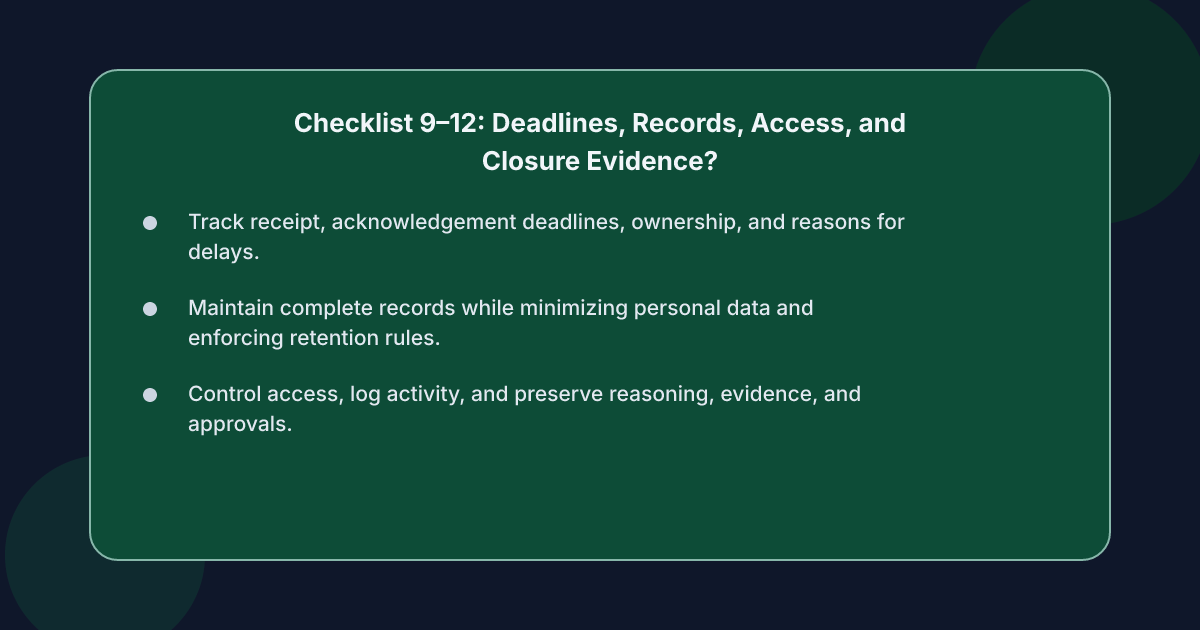 The final four checks verify that the channel produces reliable evidence of timely action, controlled access, durable records, and properly reasoned closure.
Does the system enforce and evidence statutory deadlines?
Test the acknowledgement and feedback process using real and hypothetical cases. The organisation should be able to show when the reporting period began, when action was due, who was responsible, and whether the deadline was met.
Directive (EU) 2019/1937 generally requires acknowledgement of receipt of a report within seven days, although it allows for a justified delay in limited circumstances concerning the nature and complexity of the report. A monitoring process should identify an approaching deadline before it is missed and record any justified exception.
Are records complete, accurate, and proportionate?
Sample the case file and supporting records. Check that actions, decisions, feedback, status changes, and closure reasons are accurately recorded. Records should be sufficient to reconstruct what happened without retaining irrelevant or excessive personal data.
The review should also address data minimisation, retention, and deletion. The GDPR guidance provides a practical starting point for assessing how personal data is handled across the reporting lifecycle.
Can authorised users access only the information they need?
Test access with representative roles. Users should see the information necessary for their duties, and access to sensitive reports should be restricted. Former team members and users whose responsibilities have changed should not retain inappropriate access.
Review audit logging for sign-ins, case views, changes, exports, and administrative activity. Logs should help managers investigate misuse without unnecessarily exposing report content. Where third parties participate, confirm their access is time-bound, documented, and governed by an appropriate agreement.
Does closure contain sufficient evidence and reasoning?
A closed case should record why it was closed, whether feedback was provided, what evidence supported the decision, and who approved the outcome. Close only the individual report or issue concerned; a broader investigation may remain open.
Test whether closure is distinct from deletion. Records needed for accountability should remain available according to the organisation’s retention rules, while data that no longer has a lawful or operational purpose should be removed.
When teams compare the operational effort required for manual administration with specialised tooling, ashio supports anonymous intake, two-way communication, structured case management, deadline tracking, and audit-ready records. Its published pricing is designed for EU organisations rather than individual reporters or informal networks without a formal case-handling process.
How to Score Findings and Assign Remediation Actions
A whistleblowing audit checklist produces more value when each finding has a clear severity, owner, deadline, and verification method. Scoring should reflect both the likelihood of harm and the effect on confidentiality, fairness, or regulatory compliance.
Use a simple three-level scale:
- High: The control could expose reporter identity, prevent a report from being handled, or cause a material legal deadline to be missed. Assign immediate corrective action and an accountable senior owner.
- Medium: The control is incomplete or inconsistent but does not fundamentally interrupt the reporting process. Set a defined remediation date and interim manual workaround.
- Low: The issue is mainly documentary, procedural, or a minor weakness unlikely to cause material harm. Track it in the normal improvement plan.
For every finding, record:
- The control tested and the evidence reviewed.
- The condition found, stated as an observable fact.
- The potential effect on reporters, investigations, or auditability.
- The responsible person or function.
- The corrective action and target completion date.
- The evidence required to verify closure.
Avoid unsupported conclusions. “The system is insecure” is not an audit finding; “the acknowledgement timestamp is missing in three of ten sampled cases” is testable. Where the evidence is incomplete, mark the requirement as unverified and identify what must be inspected.
A scoring matrix can also prevent serious gaps from being diluted by many minor observations. Record high-risk issues separately, even if the overall percentage appears acceptable. Re-audit the remediation rather than assuming that a policy revision alone proves the issue has been fixed.
What Evidence Should You Retain After the Audit?
Retain enough evidence to demonstrate the scope, method, findings, decisions, and remediation of the whistleblowing channel audit. The evidence package should let an auditor understand both what was tested and what was found.
A complete audit record generally includes:
- The approved scope, applicable requirements, and audit criteria.
- Dates, participants, roles, and a description of the methodology.
- The sample or population of reports examined.
- Screenshots or exports supporting findings, with confidential data minimised.
- Interview notes or questionaires that show how controls were verified.
- Recorded deficiencies, severity ratings, and explanations from control owners.
- Approved remediation plans, accountable owners, target dates, and closure evidence.
- Retest results for completed corrective actions.
- The final report and formal acceptance or approval.
Protect the audit file itself. Apply appropriate access controls, encryption, retention, and deletion rules. Do not copy report contents into presentation slides, email threads, or unrestricted shared drives without a clear purpose and lawful basis. Audit evidence should demonstrate confidentiality rather than undermine it.
Before finalisation, ask an independent reviewer to challenge the scope and sample. Did the audit test actual practice, or only documented policies? Were reporter-facing controls examined end to end? Can every high-risk finding be traced to evidence and an owner?
Frequently asked questions
How often should a whistleblowing channel be audited?
A whistleblowing channel should be audited at least annually and whenever there is a material change in the process, technology, legal framework, reporting volume, or organisational structure. Additional targeted reviews are appropriate after serious cases, control failures, or identified retaliation concerns. The frequency should be proportionate to the organisation’s risk and the complexity of its reporting arrangements.
What should a sample of whistleblowing cases include?
A useful sample includes open, recently closed, escalated, overdue, and complex cases, while protecting confidentiality and following a documented selection method. Reviewers should test intake, ownership, acknowledgement, feedback, decision-making, access, and closure across the selected files. Cases involving allegations against senior personnel or other heightened risks may warrant a separate, tightly controlled review.
Is a policy review enough for a whistleblowing compliance audit?
No. A policy review tests whether rules are written and communicated, but it does not establish that reports are handled consistently or that privacy protections work in practice. A defensible audit should also examine representative case records, interview responsible staff, test access controls, review relevant logs, and trace the reporting process from intake to closure.
How can an organisation test anonymous reporting properly?
An anonymous reporting audit should examine the full technical and operational chain rather than relying only on the absence of a name field. Reviewers should inspect the public form, data captured during submission, follow-up communication, permissions, exports, and any documentation that could reveal identity. The test should also confirm that handlers can still request and receive necessary information without weakening confidentiality.
What is the difference between closing a report and deleting it?
Closing a report is a case-management decision that records the outcome and supporting reasons. Deleting data is a separate data-governance action based on legal, operational, and retention requirements. A closed case may need to remain available for accountability, accountability reviews, or legal obligations, while information that no longer has a valid purpose should be deleted according to the applicable policy.